

Environment
Sustainability is an integral part of Geberit’s business model. An initial environmental strategy was presented as far back as 1990. Since then, the topic has been developed consistently and expanded with the addition of focal points relating to social aspects and business ethics. Today, the sustainability strategy is firmly embedded in the corporate strategy.
The materiality assessment forms the basis of the Group sustainability strategy and is regularly updated. In 2024, this was carried out for the first time as a double materiality assessment in line with the European Sustainability Reporting Standards (ESRS), and was updated in the reporting year. The sustainability strategy was updated based on this, and reflects the results of the materiality assessment, the internal risk analysis process together with external requirements from the value chain, national regulations and global frameworks. It interprets the results as operational processes and thus brings together the aspects of economic efficiency, environmental responsibility and social impact.
Energy and greenhouse gas emissions
As a Swiss company, Geberit is obliged to follow the net zero target for 2050 as targeted in the revised Swiss CO2 Act and the corresponding Swiss climate strategy. The core element of the Geberit climate transition plan is the comprehensive CO2 strategy, which was already introduced in 2022 and is integrated in the relevant business processes. The goal of the strategy is to achieve an average annual reduction in CO2 intensity of 5% (CO2 intensity is considered as Scope 1 and 2 greenhouse gas emissions in relation to currency-adjusted net sales (= relative CO2 emissions)).
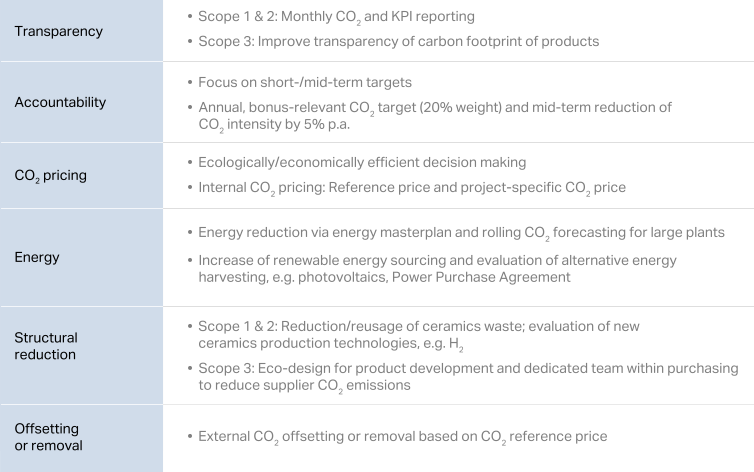
The CO2 strategy is based on six elements that lead to the long-term reduction of CO2 emissions. A central control instrument is the CO2 reference price, which was introduced in 2022 and is based on the price of the European Emissions Trading System (ETS) for CO2. For 2025, this was set at EUR 80 per tonne. This reference price embodies the costs for saving one tonne of CO2. Integrated into the project-related economic efficiency calculation, it serves as a basis for deciding on investments in measures to reduce energy or CO2 in the area of operations and properties. With the CO2 reference price, the responsibility for reducing the carbon footprint is widely supported within the company. The annual objective for reducing CO2 intensity is also relevant to bonuses and is an integral part of the variable remuneration with a weighting of 20% for Group management (220 people) as well as an additional 1,300 employees. All strategic elements in the CO2 strategy, including the most important processes and measures, are shown in the following overview:
Transparency
The annual greenhouse gas accounting (Scope 1 to 3) covers all production plants, the logistics centre in Pfullendorf and larger sales companies. Since 2012, the carbon footprint has been calculated along the value chain. Since the revision of the CO2 strategy in 2022, key figures on Scope 1 and 2 are included in the monthly reporting and forecasting processes, and audited externally as part of a limited assurance engagement. In the reporting year, the method for calculating greenhouse gas emissions (Scope 1 to 3) was revised and updated. For the first time, all relevant Scope 3 categories were calculated in full and in accordance with the requirements of the Greenhouse Gas Protocol.
Accountability
Since 2022, the annual reduction of CO2 intensity has been one of five equally weighted criteria in the calculation of the Group bonus. The achievement of goals is thus relevant to remuneration with a weighting of 20% for management and the employees in Switzerland.
CO2 pricing
See explanations to the CO2 reference price.
Energy
Measures for saving energy, increasing efficiency, heat recovery and expanding the use of renewable energies are controlled via an energy masterplan and rolling CO2 forecasts. Options include purchasing green electricity with Guarantee of Origin, long-term Power Purchase Agreements (PPA) and photovoltaic systems.
Structural reduction
In the area of ceramics (around two-thirds of Scope 1 and 2 emissions), the focus is on reducing the scrap rate, optimising the firing process and using waste heat. In the long term, alternative energy sources such as biogas or green hydrogen will be investigated. To reduce Scope 3 emissions, products have been optimised in ecodesign workshops since 2007: less material, higher repairability, greater share of recycled material, lower carbon footprint, optimised packaging and transport routes. Suppliers must maintain environmental and social standards; low-emission materials are increasingly being taken into account.
As the sixth element of the CO2 strategy, there is the option of externally offsetting or eliminating those CO2 emissions that cannot be reduced in the production process. No emissions were offset in the reporting year.
Compared to the previous year, absolute Scope 1 and 2 greenhouse gas emissions at the Geberit Group decreased in 2025 mainly due to efficiency improvements in ceramic production by 2.4% to 108,446 tonnes (previous year: 111,158 tonnes). Currency-adjusted net sales rose by 4.8%. As a result, relative CO2 emissions improved by 6.9% compared with the previous year. Since the acquisition of the energy-intensive ceramics production in 2015, relative CO2 emissions have been improved by 69.3% overall, which corresponds to an average reduction of 11.1% per year.
CO2 emissions
2015–2025
(Index: 2015 = 100)
As part of the structural reduction, processes in the area of ceramics – which accounts for two-thirds of Group-wide Scope 1 and 2 greenhouse gas emissions – are continuously optimised. The new kiln in Carregado (PT), which was installed the previous autumn, was in use for the first full year in 2025 and reduced energy consumption compared to the previous year by around 22%. At the sites in Haldensleben (DE) and Włocławek (PL), it was also possible to reduce natural gas consumption by reducing the weight of the kiln cars. The new energy-efficient powder coating plant put into operation in the reporting year at the site in Lichtenstein (DE) reduced energy consumption for the new Duofix frame production by 10% compared to 2021. At the same time, systematic efforts were made in the expansion of renewable energies. In 2025, 141.3 GWh of green electricity with Guarantee of Origin was procured, which corresponds to 67% of the total procured volume. In addition to the existing systems in Pfullendorf (DE) and Matrei (AT), a new photovoltaic system was put into operation in Lichtenstein (DE) in the reporting year, which increased the in-house production of renewable electricity by approximately 600 MWh. Increases in efficiency were also achieved through intelligent heat recovery, the modernisation of machines and lighting, the use of hybrid injection moulding systems and the optimisation of compressed air and cooling systems. Energy consumption has fallen by 30.1% since 2015 – with a simultaneous increase in net sales.
The calculation of Group-wide Scope 1 and 2 greenhouse gas emissions was again externally audited in the reporting year. Carried out by the consulting company Intep, the successful audit of the greenhouse gas balance sheet (“limited assurance”) included the calculation of CO2 emissions (Scopes 1 and 2), as well as the verification of processes on which this calculation is based. The standards of the WRI/WBCSD Greenhouse Gas Protocol and ISO 14064-1 were applied here (see also Audit Report Greenhouse Gas Balance).
Saving water
The responsible use of natural resources is one of the core elements in Geberit’s sustainability strategy. This applies in particular to water. An important lever and contribution by the company to environmental sustainability can be found in the efficient handling of water – in its own production but above all in the product use phase.
Almost 100% of the water withdrawal at Geberit can be attributed to the product use phase, i.e. the downstream value chain. In particular, the water demand of WC systems is a significant factor: according to estimates by German and Swiss sanitary industry associations, around one-third of household water requirements can be attributed to toilet flushes. Geberit consistently develops and distributes water-saving products in order to reduce water consumption in buildings. In particular, these include the optimised TurboFlush technology installed in an increasing number of Geberit toilet models, the flush valves type 208 and 212 as well as water-saving taps and urinals. Based on sales figures, there is a savings potential of up to 163 million m3 water for the reporting year compared to standard cisterns with a single 9-litre flush. The basis for this model calculation is the assumption that a 9-litre cistern is replaced with a water-saving Geberit system as part of a renovation.
The water withdrawal in production rose to 915,442 m3 (previous year 880,759 m3) in the reporting year. The increase is related to temporary measures in the technical infrastructure of a production plant. At around 80%, ceramic production accounts for the biggest share of internal water withdrawal. Compared to the reference year 2015, water withdrawal has fallen by 22%.
Keeping resources in the cycle with a focus on durability
The responsible use of materials and contribution to the circular economy are key at Geberit.
Thanks to their high quality and durability, Geberit products are designed for long use. Their service life often exceeds 50 years, for example in the case of plastic drainage pipes. Ceramic products in selected series come with a lifetime guarantee. The quality and longevity of products is supported by long-term spare parts availability – 50 years for concealed cisterns and their mechanical components, and 25 years for a significant proportion of the rest of the product range. Newly developed products and components are also largely backwards-compatible. The durability, repairability and backwards compatibility of products is one of Geberit’s key contributions to the circular economy and minimising the use of resources.
The company also follows the principle of “Avoid → Reuse → Recycle → Use elsewhere → Dispose” systematically.
Reducing waste is particularly important. The greatest leverage here can be found in production. In the reporting year, 393,832 tonnes (previous year 391,985 tonnes) of materials were processed, primarily mineral raw materials, metals and plastics, plus packaging material. The amount of waste totalled 59,970 tonnes (previous year 61,789 tonnes), of which 78% was recycled, 20% sent to landfill and 2% used for energy recovery. Since the reference year 2015, the amount of waste in production has been reduced by 28% overall.
Product sustainability and green building
Product sustainability is consistently integrated in development, material selection and the product use phase at Geberit. The central principle is the ecodesign method, which has been used since 2007 and covers the entire life cycle of a product – from obtaining the raw materials right through to disposal. Every new product should be better than its predecessor in terms of its sustainability performance. Nine ecodesign workshops were carried out in the reporting year. Current examples include the launch of the new Duofix WC element with a reduction of around 10% in its carbon footprint, the introduction of water-saving TurboFlush technology in additional toilet ceramic models, and the launch of the Type 383 fill valve with 10% ABS regranulate. The successful SuperTube technology, which offers a material-saving solution for the efficient drainage of high-rise buildings, is now also available in the highly sound-insulating version Silent-db20 SuperTube.
Since 2012, Geberit has been creating environmental product declarations (EPD) in accordance with the European standard EN 15804. EPDs present relevant, comparable and verified quantitative information about a product’s environmental impact in a transparent manner. In the reporting year, a total of 6 new EPDs were created for the product groups wall-hung WC sets, Duofix WC elements and Mapress system pipes. This means that products with an EPD account for 44% of Group sales in the reporting year (previous year 42%). Among others, this data supports sanitary engineers and building owners during LEED, DGNB and BREEAM certification and when calculating life cycle assessments for buildings.
Environmental management and compliance
The Geberit Group controls its environmental and sustainability performance with an integrated management system that incorporates quality, environment, and occupational health and safety. This system forms the framework for the continuous improvement of performance in all plants and functions. All production plants, the logistics centre in Pfullendorf (DE) and headquarters in Rapperswil-Jona (CH) are certified in accordance with ISO 9001, 14001 and 45001, with five German and three Polish plants also certified in accordance with ISO 50001 (energy). The system is complemented by Group-wide risk management and regular internal and external audits.
The sustainability performance is disclosed annually according to the GRI Standards (GRI 2021) and Art. 964a ff. CO Content Index, the recommendations of the Task Force on Climate-related Financial Disclosures (TCFD) on climate reporting, and the recommendations of the Sustainability Accounting Standards Board (SASB Index). Additionally, the reporting will also be aligned with the European Sustainability Reporting Standards (ESRS Index). The annual sustainability report shows how Geberit contributes to the UN Agenda 2030 and to the Sustainable Development Goals (SDG Index). As a member of the UN Global Compact, Geberit publishes an annual progress report on international principles for environmental and social responsibility.
Sustainability reporting
Geberit has provided comprehensive reporting in the area of sustainability since 2004; the company has reported in accordance with GRI Standards since 2006, which is reflected in very good sustainability ratings, among other aspects.
Detailed data is disclosed annually on CO2 emissions, climate risks and water consumption via the Carbon Disclosure Project (CDP). The Sustainalytics ESG Risk Rating also confirms the strong ESG position: with 15.3 points (“Low Risk”), Geberit is among the best 3% of companies in the industry (ranked 4th out of 139 in the “Building Products” sector).
These independent assessments by various rating bodies underline how sustainability is incorporated in strategy, governance and product development, and enhances the comparability for institutional investors.