

Governance structure
As a stock corporation under Swiss law, Geberit AG has a clearly defined governance structure. The General Meeting is the supreme governing body, and is convened each year within six months after the end of the financial year.
As of 31 December 2025, the Board of Directors of Geberit AG was composed of six independent, non-executive members. The proportion of independent members was thus 100%, and the proportion of female employees 33.3%. Albert M. Baehny is Chairman of the Board of Directors. The governing body is very diversified – in terms of gender, background and professional experience – and is characterised by in-depth expertise in the fields of strategic management, law, finance, ESG, human resources, marketing, digitalisation, IT security and industrial experience. In accordance with the Organizational Regulations of the Board of Directors, the Board of Directors assesses its collaboration at least once a year. This includes an assessment of how well-informed the members of the Board of Directors are about the Group and its business performance and the expertise contributed by the Board of Directors.
The term of office for a member of the Board of Directors is one year and ends at the closing of the following ordinary General Meeting. Members of the Board of Directors are elected on an individual basis. Re-election is possible. For further details, see Business Report > Corporate Governance > Board of Directors > Elections and terms of office.
The responsibilities of the Board of Directors in ESG matters include the following in particular:
Approval of the corporate strategy and sustainability strategy, including the climate transition plan and CO2 strategy
Annual assessment of material ESG impacts, risks and opportunities (e. g. according to TCFD, ESRS)
Definition of the internal CO2 reference price and ESG goals as part of the annual participation plan STP
Inspection and approval of the sustainability report in accordance with Art. 964a ff. CO
The avoidance of conflicts of interest is clearly defined by the Regulations in the Articles of Incorporation and the Organizational Regulations of the Board of Directors. The members of the Board of Directors are obliged to refrain from involvement in matters affecting either their personal interests or those of a company or people with which they have an affiliation. This obligation to refrain from involvement has no influence on the required quorum. Transactions with members of the Board of Directors or related parties must be concluded according to standard market conditions.
The Group Executive Board consists of seven members with functional management responsibility. Christian Buhl is Chief Executive Officer (CEO). The seven Group Executive Areas are:
CEO Division
Sales Europe
Sales International
Marketing & Brands
Products
Operations
Finance
The Group Executive Board is responsible for implementing the sustainability strategy and climate transition plan, plus the monitoring of ESG impacts, risks and opportunities. The members have broad expertise along the value chain – from purchasing to production and logistics, all the way through to innovation and knowledge of global markets.
The Corporate Sustainability department reports directly to the CEO. It is responsible for the further development of the sustainability strategy across the Group, controlling the achievement of objectives and Group-wide sustainability process management, including ISO certification.
Specific ESG topics are implemented decentrally by specialist functional areas:
Corporate Sustainability: environment, health and safety
Corporate Human Resources: working conditions and rights, human rights, training and further training of employees
Corporate Legal Services: competition law, prevention of corruption, data protection
Corporate Purchasing: due diligence in procurement and the supply chain, human rights in the supply chain
Sales: training and further training in the downstream value chain
These units report directly to the CEO or the responsible member of the Group Executive Board.
All positions involved in the sustainability strategy and its implementation and ESG reporting, with the corresponding responsibilities, are listed in the graphic below.
ESG governance at Geberit
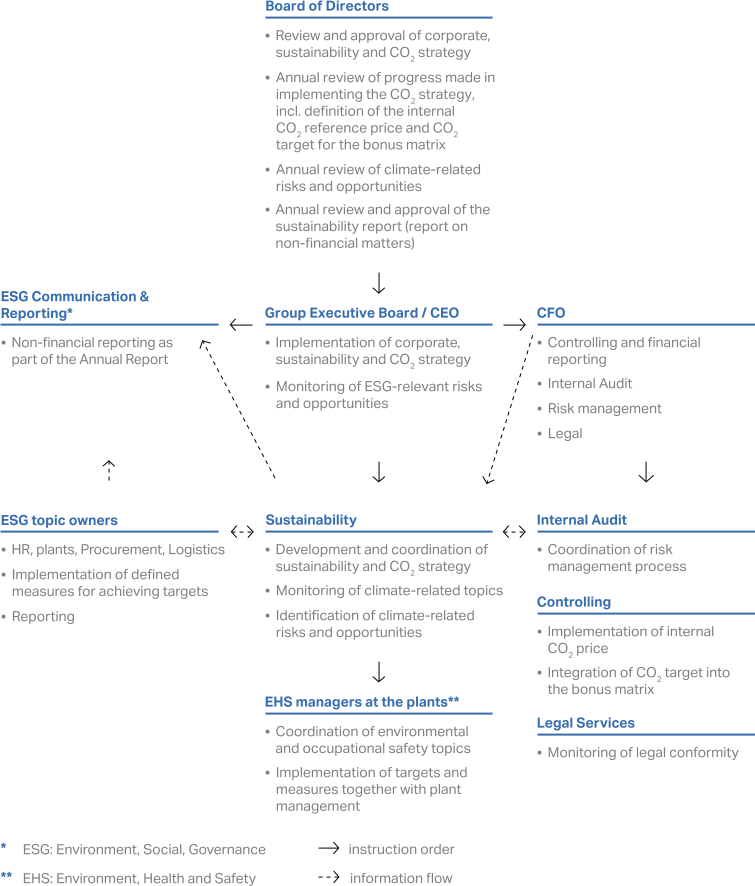
Training takes place on a regular basis to safeguard the ESG expertise in the supervisory and management body, for example on ESG regulation, the recommendations of the Task Force on Climate-related Financial Disclosures (TCFD) or the EU Taxonomy.
ESG integration in decision making
ESG topics are systematically integrated in strategic, operative and transactional decision-making processes. ESG-related aspects are dealt with explicitly as part of the following:
The double materiality assessment according to ESRS
Revision of the sustainability strategy
Monitoring of the carbon footprint
Investments in energy efficiency
Assessment of investments according to internal CO2 reference price
Due diligence processes in the supply chains
ESG reporting, including TCFD-compliant disclosure
In addition, the following are carried out on an annual basis:
Review of the implementation of the Code of Conduct (Code of Conduct reporting)
Assessment of due diligence obligations in the supply chain relating to human rights and the environment
The Board of Directors is also available to address the concerns of stakeholders and shareholders, see Business Report > Corporate Governance > Participatory rights of shareholders. Matters brought forward by shareholders within the context of the General Meeting are dealt with in accordance with the Articles of Incorporation of Geberit AG. No matters were submitted directly to the Board of Directors outside the General Meeting in 2025.
The employee representatives of the European sites meet twice a year with a member of the Group Executive Board and the Head Corporate Human Resources. Concerns can be addressed to the Board of Directors through this channel.
ESG key figures and remuneration architecture
The remuneration policy of the Geberit Group follows the principles of responsible business management. It is approved by the Board of Directors and reviewed annually. The General Meeting approves both the maximum amounts of remuneration and the remuneration report. The Group’s remuneration policy balances short-term success and long-term value creation. Sustainability goals are an integral part of variable remuneration: the annual reduction of CO2 intensity is one of the five equally weighted bonus criteria and is relevant to the remuneration of around 220 managers and a further 1,300 employees of the Group.
For information about the remuneration of the management bodies, see Business Report > Remuneration Report. For annual key figures on the ratio of the annual remuneration and non-discrimination in the remuneration policy, see Social matters – Performance 2025 > Own workforce.