

Value chain
Value chain at Geberit
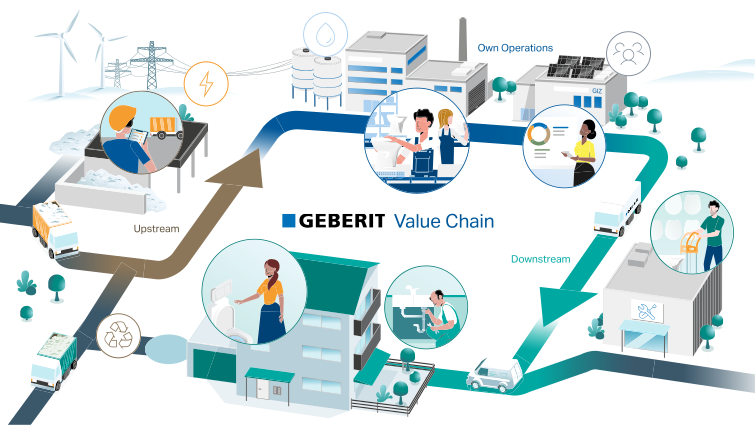
Geberit is a key player in the value chain seen in building technology and technical building systems. The company manufactures sanitary products and systems that are installed in buildings by specialist planners and qualified professional installers. Its business activities affect suppliers, employees, direct and indirect customers, as well as end users across different regional economic areas.
As at the end of the reporting year, the Geberit Group’s production network comprised 26 plants, including 22 in Europe, two in the United States, and one each in China and India. This network is complemented by a logistics centre in Germany, a further 13 distribution centres in Europe, and one in China.
Production network at Geberit
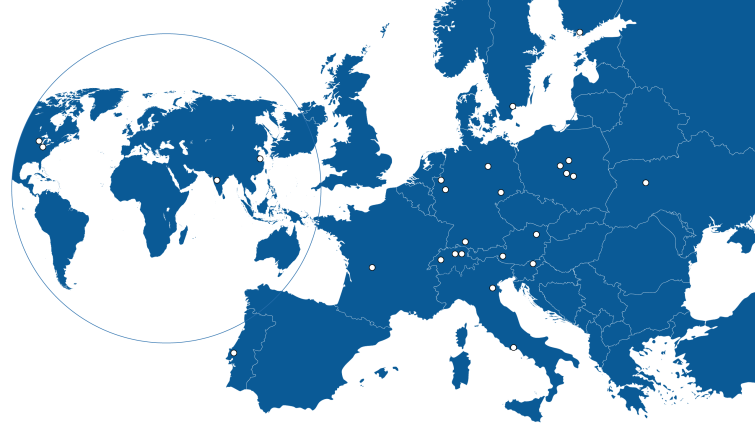
The company has sales companies or representative offices in 52 countries, 28 of which are located in Europe, 12 in the Middle East/Africa region, one in the USA and 11 in Asia and Oceania.
The company creates additional added value by sharing knowledge: specialists from around the world are trained in new technologies, product applications, software solutions and installations at 30 Geberit Information Centres and at external events with sales partners.
Products are sold in over 120 countries. In 2025, net sales amounted to a total of CHF 3,163 million (previous year CHF 3,085 million). For detailed information on net sales by various categories, see Business Report > Business and financial review > Financial Year 2025 > Net sales. Significant indicators for the creation and distribution of value can be found in the Consolidated financial statements Geberit Group and Geberit share information.
Net sales by markets/regions
2025
Own workforce
As at the end of the reporting year, the workforce comprised 11,278 full-time positions. Of these, 57% were employed in Production, 29% in Marketing & Sales, 3% in Research & Development, and 9% in Administration. The company also supports vocational training: 289 apprentices (2%) were employed at the end of 2025. Regionally, the jobs were distributed as follows:
Regional distribution of direct employees: number and share of the workforce
Upstream value chain
In 2025, Geberit had business relationships with 1,404 direct suppliers. Additionally, the company worked with 49 external logistics partners as it does not have a transport fleet of its own. Business partnerships are based on a binding Code of Conduct for Suppliers and Business Partners, which defines standards for quality, environment, occupational health and safety, and human rights.
As of end 2025, the geographic distribution by number of suppliers and their share of sales was as follows:
Regional distribution of direct suppliers: number and share of procurement spend
Downstream value chain
The products and services are used exclusively in building construction, either in residential or non-residential construction. In terms of marketing, the company follows a three-stage sales model based on the following two principles:
Focus on key decision-makers and long-term customer relations: In order to build a strong reputation, close relationships are maintained with the most important market players.
Adaptation to regional differences: The model is applied worldwide and adapted according to country-specific decision-making structures.
Market development in the European sanitary industry is made on several levels, as shown in the following figure:
Sales model
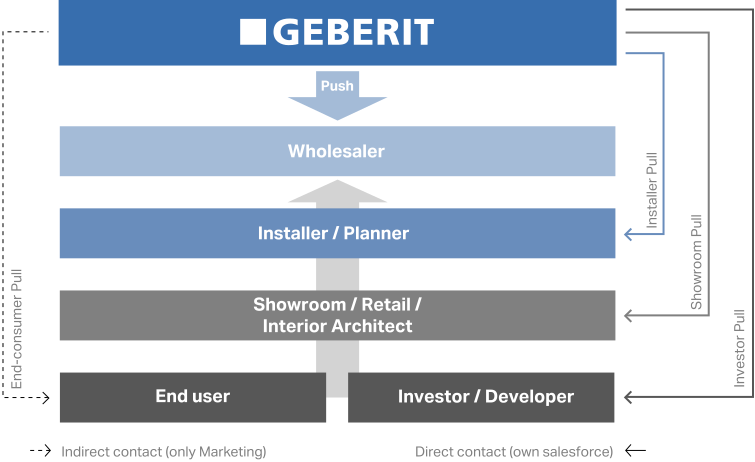
Geberit sells the majority of its products through sanitary wholesalers. The main customers at wholesalers are plumbers who install the Geberit products and solutions in buildings. In the product areas Installation and Flushing Systems and Piping Systems (“behind the wall”), planning offices and plumbing companies are among the most important decision-makers. Geberit supports these partners with Technical Advisory Services, digital planning tools (e. g. BIM) and in-person and online training courses. The personal contact by field service to this customer group in the form of the “technical pull” is a key element in market support.
Other customer groups include end customers and real estate investors and developers, who are addressed with products “in front of the wall” – particularly the product area Bathroom Systems. They are targeted either indirectly via exhibitions and showrooms, or directly via project-related collaboration – supplemented by online and offline marketing campaigns tailored to the target groups.
Thanks to this differentiated market cultivation, Geberit ensures that both specialists and end customers are addressed in an appropriate way and that the high level of product and service quality is maintained across the entire value chain.
Geberit does not carry out any activities in high-risk sectors and does not sell forbidden products.