

Climate change and energy
Overview
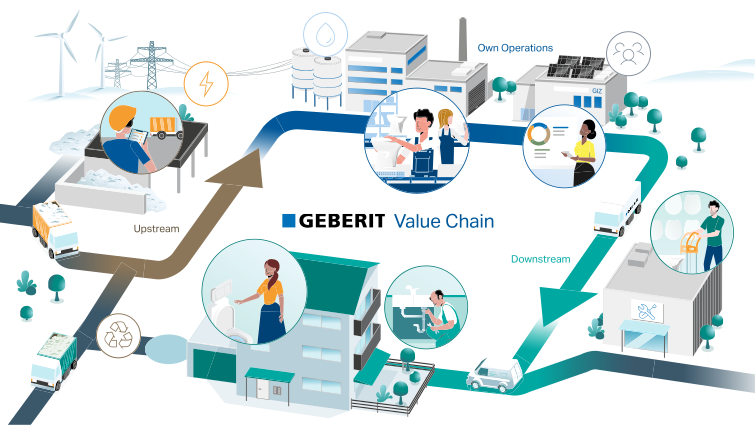
The significance of the topic of “Climate change and energy” in the Geberit value chain
Reduction of CO2 intensity
Reduction of absolute CO2 emissions
Share of electricity from renewable sources
Impacts, risks and opportunities
As part of the double materiality assessment carried out for the first time in 2024, Geberit identified and assessed material impacts, risks and opportunities (IRO) in relation to climate change. It focused on energy consumption and greenhouse gas emissions along the entire value chain – from the provision and transport of raw materials through production and logistics to the product use phase, followed by recycling or disposal.
In addition, a scenario-based, quantitative analysis of climate-related risks was carried out in 2025. This involved the identification and assessment of core physical and transitional climate-related risks and their integration into the existing risk management system (Enterprise Risk Management, ERM).
Based on the results, the previously identified impacts and opportunities were updated and further clarified, as summarised below:
The opportunity arises in relation to sanitary solutions for extreme weather events caused by climate change, for example in the event of extreme precipitation.
The positive impact results from the use of resource-saving sanitary solutions, which play a role in climate change adaptation in water-scarce regions in particular.
The negative impact is caused by the CO2 emissions arising along the value chain, especially in relation to the provision of raw materials, logistics and the disposal of products at the end of their life cycle.
The material impacts and opportunities identified in the area of “Climate change and energy” are presented below. They relate to all three dimensions of the area: “Climate change adaptation”, “Containment measures” and “Energy”:
|
|
|
|
Time horizon |
|
Value chain |
||||||||
IRO description |
|
Type |
|
Short- |
|
Medium-term |
|
Long- |
|
Up- |
|
Own operations |
|
Downstream |
Geberit products support a sparing use of water as a resource (through water-saving sanitary systems), which contributes to climate change adaptation in water-scarce regions. |
|
Positive impact, actual |
|
|
|
|
|
|
|
|
|
|
|
|
Geberit’s business activities result in CO2 emissions along the entire value chain, particularly in raw materials, logistics and disposal. |
|
Negative impact, actual |
|
|
|
|
|
|
|
|
|
|
|
|
Extreme weather events caused by climate change may increase demand for Geberit sanitary solutions, thereby creating additional market or sales potential for Geberit. |
|
Opportunity, potential |
|
|
|
|
|
|
|
|
|
|
|
|

Scenario analysis
In the reporting year, the analyses of physical and transitional climate risks were drawn up taking various socioeconomic scenarios (shared socioeconomic pathways, SSPs) into account for the first time and linked to the materiality assessment. The scenarios analysed considered three time horizons that differ from the periods used elsewhere in the report: short-term (until 2028), medium-term (2029–2035) and long-term (2036–2050).
Physical risks
Physical risks include acute extreme events (e. g. extreme precipitation, flooding) as well as chronic changes (e. g. temperature increase, periods of drought).
Climate-related risks were considered for all production sites and the logistics centre in Pfullendorf (DE). Various scenarios for socioeconomic development (SSPs) or representative concentration pathways (RCPs) were applied:
SSP1-2.6 “Sustainable”
SSP2-4.5 “Middle of the road”
SSP5-8.5 “Fossil-fuelled development”
Further information, assumptions and the assessment logic are explained in the Annex.
Two material risk categories were identified:
Flooding (rivers, extreme precipitation, storm surges, tropical cyclones): risk of property damage and operational disruptions, risk for occupational safety.
Heat and aridity (extreme heat, drought, water stress; including forest fires/cold snaps): risk of operational disruptions, for occupational safety and of property damage.
Further risk categories (e. g. rise in sea level, melting permafrost) have been examined and classified as non-material with regard to the production sites and the logistics centre in Pfullendorf (DE).
Result: Even under SSP5-8.5, the overall risk of flooding by 2050 is low and stable as a whole. A slight increase in rainfall should be anticipated in some areas. Exposure to heat and aridity is also low, although some locations display increased sensitivity.
Control: The categories are fully incorporated in the risk management system. Locations are prioritised according to risk level. Measures include protection against heat and flooding, infrastructure adjustments and emergency concepts (e. g. for flooding, landslides and storms). The Corporate Sustainability department reviews risks and changes in line with the risk management cycle.
Transitional risks
Transitional risks and opportunities arise as a result of regulatory, technological, market-related and social developments. Geberit regularly assesses their financial relevance as part of risk management. The analysis of transitional climate risks was carried out on a quantitative basis for the first time in the reporting year and integrated into the Group’s climate risk management system. In future, it will be reviewed and assessed in line with the risk management cycle.
Two factors have been identified as potentially relevant transitional risks:
CO2 pricing: Mechanisms such as the European Union Emissions Trading System (EU-ETS) and the EU ETS-2 planned for 2027 onwards as well as the European Carbon Border Adjustment Mechanism (CBAM) lead directly and indirectly to rising energy prices and CO2 surcharges along the supply chain and therefore to higher production and procurement costs.
Investments in low-CO2 production technologies: Stricter requirements for net zero emissions by 2050 may accelerate investments in low-CO2 technologies, in particular in ceramics plants with the highest Scope 1 and 2 emissions. This harbours risks of higher investment and energy costs as well as potential impairments of existing assets.
Result: Based on the assumptions set out in the Annex and the projections of the International Energy Agency (IEA) in the “Stated Policies Scenario” (STEPS, “middle of the road”), the risk resulting from CO2 pricing is classified as “medium” over the short term. The risk of additional investments in low-CO2 production technologies is currently assessed as “low”. Both risks are below the materiality threshold and therefore do not qualify as material; however, they will be continuously monitored.
Control: Geberit addresses transitional risks through the CO2 strategy as well as a technology-flexible transformation pathway for kilns in ceramics plants along with energy-efficient and CO2-efficient solutions. Implementation is scenario-based and takes account of technological maturity, financial viability and integrated capital allocation.
Conclusion of the scenario analysis
The analysis of physical risks confirms potential negative impacts due to operational disruption and property damage and has resulted in targeted resilience measures at prioritised sites.
The transitional influencing factors have an impact on cost and investment pathways, while at the same time also supporting the opportunities identified in the materiality assessment for durable, energy-efficient, water-saving and resource-saving products. At the same time, they reduce the negative impacts of greenhouse gas emissions within the value chain by creating incentives for the decarbonisation of procurement and production.
Overall, scenario analyses increase planning reliability within a volatile socioeconomic environment – for example, with regard to future CO2 price pathways – and boost the strategic resilience of Geberit’s business model.
The risks considered are below the materiality threshold and will be continuously monitored. At the same time, growth opportunities open up due to rising environmental awareness and increasing demand for efficient, low-CO2 solutions, for example.
Management system
Climate change is an integral part of the sustainability strategy and is anchored at the highest management level. The Board of Directors adopts the CO2 strategy as a core element of Geberit’s climate transition plan, monitors the assessment of physical and transitional risks and the achievement of the annual, remuneration-relevant objective for reducing CO2 intensity of 5%, and approves the internal CO2 price. The Group Executive Board is responsible for implementing the CO2 strategy, controlling the respective risk analyses and for the derivation of the necessary corrective measures. The Group-wide management of sustainability processes – including the control of environmental matters – is the responsibility of Corporate Sustainability.
Climate-related risks are integrated into the risk management system. All sites have business continuity management systems in place with defined measures that are regularly updated. Production is subject to demanding energy and efficiency standards. The five German plants (Lichtenstein, Pfullendorf, Langenfeld, Wesel and Haldensleben) and the three Polish plants (Koło, Włocławek and Ozorków) are certified in accordance with ISO 50001 (energy). Developments in EU legislation for energy-intensive industries are monitored on an ongoing basis in order to ensure strategic adjustment at an early stage.
Strategies and policies
As a company with its headquarters in Switzerland, Geberit is obliged to follow the net zero target for 2050 as targeted in the revised Swiss CO2 Act and the corresponding Swiss climate strategy. Net zero means that, by 2050, Switzerland will only emit as many greenhouse gases as can be removed from the atmosphere or compensated for. In accordance with the Paris Agreement of 2015, the Swiss net zero target should contribute to limiting global warming to considerably under 2 °C, ideally 1.5 °C, compared to pre-industrial values.
Climate transition plan and the CO2 strategy
The core element of the Geberit climate transition plan is the Group-wide CO2 strategy introduced in 2022, which is already anchored in all relevant business processes and covers Scope 1 and 2 emissions. It is based on six strategic elements:
Transparency
The annual greenhouse gas balance (GHG balance) covers all production plants, the logistics centre in Pfullendorf (DE) and larger sales companies. Since 2012, the carbon footprint has been calculated along the value chain. Since the revision of the CO2 strategy in 2022, key figures on Scope 1 and 2 are included in the monthly reporting and forecasting processes, and audited externally as part of a limited assurance engagement. The method for calculating greenhouse gas emissions (Scope 1 to 3) including boundaries and exclusions was fully revised in the reporting year. For the first time, all relevant Scope 3 categories were calculated in full and in accordance with the requirements of the Greenhouse Gas Protocol, see the Annex.
Accountability
Since 2022, the annual reduction of CO2 intensity has been one of five equally weighted criteria in the calculation of the Group bonus. The goals are thus relevant to remuneration with a weighting of 20% for management and the employees in Switzerland.
CO2 reference price
The internal CO2 price mechanism with an annually defined CO2 reference price is a key component of the CO2 strategy. The Group Executive Board proposes this price as part of the budget process; approval is made by the Board of Directors. In 2025, the internal reference price was EUR 80 per tonne of CO2, based on the European Emissions Trading System (EU-ETS). The area of application of internal CO2 pricing covers Scope 1 and 2 emissions.
The CO2 price is systematically applied within decision-making processes and is a mandatory part of economic efficiency calculations for investment projects. CO2 emissions are then regarded as economically relevant costs and environmentally friendly investments are prioritised. At project level, the implicit CO2 price is also used to realistically project the long-term impacts of potential investments and to reveal the sensitivity of projects in terms of future CO2 costs.
This mechanism enhances the alignment of investments to technologies that save energy and reduce emissions, increases the transparency of the foundations on which decisions are made and creates Group-wide incentives for reducing the carbon footprint. At the same time, responsibility for the achievement of climate targets is broadly anchored throughout the company and integrated into daily business activities.
Energy
Measures for saving energy, increasing efficiency, heat recovery and expanding the use of renewable energies are controlled via an energy master plan and rolling CO2 forecasts. Options include purchasing green electricity with Guarantee of Origin (GoO), long-term Power Purchase Agreements (PPA) and photovoltaic systems.
Structural reduction
In the area of ceramics (around two-thirds of Scope 1 and 2 emissions), the focus is on reducing the scrap rate, optimising the firing process and using waste heat. In the long term, alternative energy sources such as biogas or green hydrogen will be investigated. To reduce Scope 3 emissions, products have been optimised in ecodesign workshops since 2007: less material, higher repairability, greater share of recycled material, lower carbon footprint, optimised packaging and transport routes. Suppliers must maintain environmental and social standards; low-emission materials are increasingly being taken into account.
Offsetting or removal
As the sixth element of the CO2 strategy, there is the option of externally offsetting or eliminating those CO2 emissions that cannot be reduced in the production process.
Geberit’s CO2 strategy was reviewed in 2022 by an independent external stakeholder panel comprised of experts in science, business and sustainability and rated as ambitious and exemplary. The panel stated as follows in the Annual Report 2022:
“Geberit’s new CO2 strategy focuses on concrete measures with a medium-term time scale. In the opinion of the panel, the well-thought-out mechanisms connected to the internal CO2 price and the integration of binding CO2 emission criteria in operational business planning and in the incentives for management and part of the workforce (bonus relevance) are exemplary.”
The external assessment underscores the strategic consistency and credibility of Geberit’s decarbonisation targets.
Energy master plan
The energy master plan sets out the most important levers for reducing energy consumption and CO2 emissions in the ceramics plants. These include efficiency programmes, the increased use of heat recovery, optimised load management and the gradual modernisation of kilns through to energy-efficient and increasingly environmentally friendly technologies.
Risk analyses
Another aspect of the climate transition plan is the strategic management of climate-related risks and opportunities. These are discussed in detail in the chapter Risk management and in the section Impacts, risks and opportunities in this chapter. The basic principle is that economic, environmental and social perspectives are considered within all decision-making processes.
By consistently integrating the sustainability strategy and CO2 strategy into the core business, Geberit is reducing adverse climate-related impacts and seizing the identified opportunities, for example by developing water-saving and resource-saving products. Regulatory developments – including EU-ETS, EU-ETS2 and CBAM – are continuously monitored in order to align strategy, procurement and investments with the future in mind.
Targets
Geberit is pursuing an implementation-oriented and measurable reduction pathway for CO2 emissions in Scope 1 and 2.
Scope 1 and 2
Reference metric: absolute emissions in relation to currency-adjusted net sales (CO2 intensity)
Objective:
-5% CO2 intensity per year on average (target relevant to remuneration)
Baseline year: 2015
Period: 2015–2035
Since the introduction of the CO2 strategy in 2022, Geberit has continuously reduced its Scope 1 and Scope 2 emissions. In line with the medium-term goal of reducing CO2 intensity in future by an average of 5% per year, the development of absolute emissions is compatible with the short-term goal of the Science Based Targets initiative (SBTi) of reducing Scope 1 and Scope 2 emissions by 42% by 2030.
Scope 3
No quantitative goals for Scope 3 emissions were set in the reporting year. The focus was placed on cooperation with suppliers with a view to developing initiatives for specific categories and material groups – in particular for CO2-intensive materials such as plastics and metals. This includes enhancing data transparency, improving emissions factors and devising joint action plans along the supply chain.
The initiatives connect short-term to long-term milestones and create clear incentives for investments and procurement decisions. They strengthen strategic resilience to physical and transitional climate risks.
Processes, measures and controls
The most important levers for reducing energy consumption and CO2 emissions are anchored in the CO2 strategy and in the energy master plan. These are centred on saving energy, increasing efficiency, heat recovery and increasingly decarbonised energy procurement in the plants.
Annual recording and consolidation of all GHG-relevant data forms the backbone of greenhouse gas accounting. It covers all production plants, the logistics centre in Pfullendorf (DE), other logistics units and sales companies in major sales markets.
In parallel, Geberit is increasing the transparency of Scope 3 emissions – on one hand at product level through environmental product declarations (EPD) and on the other at material group level in the supply chain.
Greenhouse gas reduction measures
Ceramic production causes around two-thirds of Scope 1 and 2 emissions and thus offers the greatest reduction potential. The focus is placed on lower scrap and refiring rates, process optimisations, heat recovery and the examination of alternative combustion and process technologies (e. g. based on hydrogen, biogas, electrification/hybrid solutions). Investments are prioritised based on implicit CO2 project prices.
Examples from the reporting year:
Reduction of energy requirements and CO2 emissions in the plants in Haldensleben (DE) and Włocławek (PL) due to lighter kiln cars.
Reduction of specific energy consumption of Duofix frame production by 10% compared to 2021 through commissioning of a new powder coating plant at the plant in Lichtenstein (DE).
Heat recovery from air compressors at the plant in Włocławek and from the annealing furnace at the plant in Ozorków (PL).
Better insulation of the heating system at the plant in Włocławek in order to reduce heat losses.
Procurement of new, more energy-efficient injection moulding machines at the plants in Shanghai (CN), Ruše (SI) and Pfullendorf (DE).
Installation of LED lighting at the plants in Ruše and Gaeta (IT).
Installation of a new heating system with an air-to-air heat pump at the plant in Langenfeld (DE).
Installation of PV panels at the plant in Lichtenstein and purchase of green electricity at the plant in Haldensleben.
Power supply and energy efficiency within own operations
Geberit is systematically expanding the proportion of renewable energy with the aim of decarbonising electricity and heat procurement, which is financially underpinned by the internal CO2 price. The instruments currently include Guarantees of Origin and photovoltaic systems for generating energy at plants. In addition, energy standards and fleet requirements secure efficiency gains:
The five German and three Polish plants are certified according to ISO 50001 (energy).
Group-wide CO2 emission thresholds have been defined for vehicle procurement, and incentives for electric vehicles have also been created.
A fully electric vehicle has been used since 2025 for the internal handling of trailers and swap bodies in the logistics centre in Pfullendorf (DE).
Reduction measures in the value chain
Along the upstream and downstream value chain, the measures aim to achieve emission reductions on the materials side, higher recycling rates and short, regional supply routes. Since 2007, new products and product developments have been systematically optimised throughout the entire product life cycle in line with the eco-design approach. In addition, optimised routes, better capacity utilisation and packaging are reducing energy consumption in logistics.
Examples of energy savings in downstream logistics:
The latest vehicle technologies are used in order to enhance energy efficiency within intercompany logistics and distribution logistics; the share of Euro 6 trucks is 90.3% (previous year 86.2%) and HVO diesel (hydrotreated vegetable oil) is being increasingly used.
High-capacity transport with two trailers (up to 35 metres long) are used between the ceramics plants in Bromölla (SE) and Ekenäs (FI). Thanks to the double loading capacity and the use of HVO fuel, CO2 emissions can be reduced by up to 95% compared to traditional, diesel-powered trucks.
For several years, goods have been transported using combined transport (rail, road and water) on various European routes.
Electric trucks are used on the route between Rapperswil-Jona (CH) and the logistics centre in Pfullendorf (DE). In addition, electric trucks are used on various other routes (including cross-border routes).
Examples of energy savings through products and services:
The new Duofix element for wall-hung WCs is produced using fewer materials and partially with green electricity, resulting in a CO2 reduction of around 10% compared to its predecessor.
The AquaClean Sela Comfort shower toilet with WhirlSpray and heating-on-demand technology results in lower energy consumption.
The energy retaining valve ERV avoids heat loss and saves customers around 50 litres of heating oil per year.
Water- and energy-efficient urinal systems, waterless in some cases, optionally with an autonomous energy source (e. g. Preda, Selva).
Modular tap system with reduced water and energy consumption.
Geberit Control App for ongoing optimisation of water and energy management.
Controls and disclosure
Climate-relevant key figures are an integral part of monthly reporting and budget processes. Any discrepancies trigger standardised countermeasures within plants, procurement and R&D. The internal CO2 price, the energy master plan, the ecodesign approach and a structured supplier management system create an integrated control system that prioritises economically viable decarbonisation steps, ensures regulatory compliance and enhances competitiveness through efficient, durable products. Targets, measures and progress are disclosed transparently through the Carbon Disclosure Project (CDP) and within key figures for energy, emissions and environmental performance, amongst others.
Measures and key figures in the reporting year
Energy consumption
Direct and indirect energy sources
Geberit generally uses energy purchased externally. The direct energy carriers include the combustibles natural gas, biogas, liquefied petroleum gas (LPG), diesel for power generation, heating oil extra light, as well as fossil motor fuels such as diesel and gasoline. Combustibles (primarily for ceramic production), including district heating, still make up the main energy carriers at 62.8% (previous year 64.5%), followed by electricity with 33.2% (previous year 31.8%), of which 67.5% from renewable sources, and fuels with 4.0% (previous year 3.7%). The indirect energy carriers include electricity and district heating.
Thanks to increases in efficiency, Geberit’s energy consumption fell compared to the previous year by 1.9% to 637.5 GWh (previous year 649.9 GWh). Of this figure, 72.3% came from fossil energy carriers (including combustibles and motor fuel, district heating and electricity from fossil fuels).
|
|
2025 |
|
2024 |
|
Deviation |
||||
|---|---|---|---|---|---|---|---|---|---|---|
|
|
MWh |
|
MWh |
|
% |
||||
Natural gas |
|
310,273 |
|
329,362 |
|
-5.8 |
||||
Liquefied petroleum gas (LPG) |
|
67,258 |
|
67,348 |
|
-0.1 |
||||
Light heating oil |
|
5 |
|
17 |
|
-70.6 |
||||
Diesel for electricity generation |
|
492 |
|
575 |
|
-14.4 |
||||
Vehicle fuel from fossil sources |
|
25,412 |
|
23,750 |
|
7.0 |
||||
Fuel consumption from fossil sources |
|
403,442 |
|
421,052 |
|
-4.2 |
||||
Purchased district heating from fossil sources |
|
804 |
|
748 |
|
7.5 |
||||
Purchased electricity from fossil sources |
|
56,648 |
|
60,159 |
|
-5.8 |
||||
Total energy consumption from fossil sources |
|
460,895 |
|
481,960 |
|
-4.4 |
||||
Purchased electricity from nuclear sources |
|
12,169 |
|
12,205 |
|
-0.3 |
||||
Total energy consumption from nuclear sources |
|
12,169 |
|
12,205 |
|
-0.3 |
||||
Biogas |
|
6,106 |
|
6,706 |
|
-8.9 |
||||
Fuel consumption from renewable sources |
|
6,106 |
|
6,706 |
|
-8.9 |
||||
Purchased district heating from renewable sources |
|
15,663 |
|
14,486 |
|
8.1 |
||||
Self-produced electricity from renewable sources |
|
1,418 |
|
230 |
|
516.5 |
||||
Purchased electricity from renewable sources |
|
141,257 |
|
134,324 |
|
5.2 |
||||
Total energy consumption from renewable sources |
|
164,444 |
|
155,745 |
|
5.6 |
||||
Total energy consumption |
|
637,508 |
|
649,909 |
|
-1.9 |
||||
Share of fossil sources in total energy consumption (%) |
|
72.3 |
|
74.2 |
|
-2.6 |
||||
Share of nuclear sources in total energy consumption (%) |
|
1.9 |
|
1.9 |
|
1.6 |
||||
Share of renewable sources in total energy consumption (%) |
|
25.8 |
|
24.0 |
|
7.6 |
||||
|
||||||||||
Renewable energies accounted for 25.8% of overall energy consumption (previous year 24.0%). These include fuels such as biogas and district heating from renewable sources, such as usage of waste heat from a nearby paper factory or district heating from a block heating station powered by wood chippings in two ceramics plants. This is in addition to electricity from renewable sources either through Guarantees of Origin or internally produced solar energy from photovoltaic systems.
The share of renewable energies for district heating and combustibles was 5.4% in total in 2025 (previous year 5.1%). The block heating station in Pfullendorf (DE), which was commissioned in 2012 and which was fed by 5.9 GWh of regionally generated biogas in 2025, makes a key contribution. The electricity generated (2.0 GWh) is fed into the power supply system, whereas the resulting heat (3.0 GWh) can be used in production. In the ceramics plants, 15.7 GWh of district heating was sourced from a paper factory and a block heating station.
|
|
2025 |
|
2024 |
|
Deviation |
||||
|---|---|---|---|---|---|---|---|---|---|---|
|
|
MWh |
|
MWh |
|
% |
||||
Purchased electricity from renewable sources |
|
141,257 |
|
134,324 |
|
5.2 |
||||
One-time purchased Guarantees of Origin (GoO) |
|
141,257 |
|
134,324 |
|
5.2 |
||||
Self-produced electricity from renewable sources |
|
1,418 |
|
230 |
|
516.5 |
||||
Total electricity consumption |
|
211,493 |
|
206,918 |
|
2.2 |
||||
Share of renewable sources in total electricity consumption (%) |
|
67.5 |
|
65.0 |
|
3.7 |
||||
|
||||||||||
Systematic efforts are being made in the expansion of renewable energies. In the reporting year, electricity consumption from renewable sources rose by 8.1 GWh to 142.7 GWh (previous year 134.6 GWh), which corresponds to around 67.5% of the entire volume of purchased electricity (previous year 65.0%). This is comprised of purchased green electricity with Guarantee of Origin and electricity produced by proprietary photovoltaic systems.
A new photovoltaic system with a capacity of around 900 kWp was put into operation at the plant in Lichtenstein (DE) in the reporting year. It supplements the systems installed in the previous year in Pfullendorf (DE) and Matrei (AT). Overall, the three PV systems are expected to generate 1.8 GWh of electricity each year (previous year 1.0 GWh).
|
|
2025 |
|
2024 |
|
Deviation |
||||
|---|---|---|---|---|---|---|---|---|---|---|
|
|
MWh |
|
MWh |
|
% |
||||
Europe |
|
443,166 |
|
463,853 |
|
-4.5 |
||||
Americas |
|
8,852 |
|
8,819 |
|
0.4 |
||||
Asia/Pacific |
|
8,877 |
|
9,288 |
|
-4.4 |
||||
Total energy consumption from fossil sources |
|
460,895 |
|
481,960 |
|
-4.4 |
||||
Europe |
|
10,685 |
|
10,668 |
|
0.2 |
||||
Americas |
|
1,221 |
|
1,254 |
|
-2.6 |
||||
Asia/Pacific |
|
262 |
|
283 |
|
-7.4 |
||||
Total energy consumption from nuclear sources |
|
12,169 |
|
12,205 |
|
-0.3 |
||||
Europe |
|
164,444 |
|
155,745 |
|
5.6 |
||||
Americas |
|
0 |
|
0 |
|
- |
||||
Asia/Pacific |
|
0 |
|
0 |
|
- |
||||
Total energy consumption from renewable sources |
|
164,444 |
|
155,745 |
|
5.6 |
||||
Europe |
|
618,296 |
|
630,265 |
|
-1.9 |
||||
Americas |
|
10,073 |
|
10,073 |
|
0.0 |
||||
Asia/Pacific |
|
9,139 |
|
9,571 |
|
-4.5 |
||||
Total energy consumption |
|
637,508 |
|
649,909 |
|
-1.9 |
||||
|
||||||||||
Broken down according to region, the bulk (97.0%) of energy is consumed in Europe, with 1.6% in the Americas and 1.4% in the Asia/Pacific region. The regional distribution remained unchanged in the reporting year compared to the previous year.
Since the acquisition of the energy-intensive ceramics business in 2015, energy consumption has been reduced by 30.1% overall.
Emissions in Scopes 1 and 2
The Geberit GHG Accounting Methodology (Scope 1-3 emissions) including boundaries and exclusions was fully revised and updated in the reporting year. As a result, all figures for 2023 and 2024 have been recalculated and are restated in this report.
Since the acquisition of the energy-intensive ceramics production in 2015, the Geberit Group has been able to reduce absolute CO2 emissions (Scope 1 and 2) by 55.2%.
Scope 2 emissions comprise emissions from the energy purchased externally by the company, in particular electricity and heat. They are calculated using both location-based and market-based methods.
In the location-based approach, emissions are determined according to the average energy mix of the respective local power supply. In contrast, market-based emissions are based on the specific emission factors of the electricity products actually purchased and take into account contractual agreements and Guarantees of Origin. The comparison between location-based and market-based values underscores the impact of procurement decisions on Scope 2 emissions.
|
|
2025 |
|
2024 |
|
Deviation |
||||||
|---|---|---|---|---|---|---|---|---|---|---|---|---|
|
|
t CO2e |
|
t CO2e |
|
% |
||||||
Europe |
|
84,579 |
|
88,315 |
|
-4.2 |
||||||
Americas |
|
1,150 |
|
1,052 |
|
9.3 |
||||||
Asia/Pacific |
|
142 |
|
212 |
|
-33.0 |
||||||
Total Scope 1 GHG emissions |
|
85,871 |
|
89,578 |
|
-4.1 |
||||||
Europe |
|
15,567 |
|
14,004 |
|
11.2 |
||||||
Americas |
|
1,582 |
|
1,820 |
|
-13.1 |
||||||
Asia/Pacific |
|
5,425 |
|
5,756 |
|
-5.8 |
||||||
Total Scope 2 GHG emissions – market-based |
|
22,574 |
|
21,581 |
|
4.6 |
||||||
Europe |
|
61,668 |
|
58,388 |
|
5.6 |
||||||
Americas |
|
1,582 |
|
1,820 |
|
-13.1 |
||||||
Asia/Pacific |
|
5,425 |
|
5,756 |
|
-5.8 |
||||||
Total Scope 2 GHG emissions – location-based |
|
68,675 |
|
65,965 |
|
4.1 |
||||||
Europe |
|
100,146 |
|
102,319 |
|
-2.1 |
||||||
Americas |
|
2,732 |
|
2,872 |
|
-4.9 |
||||||
Asia/Pacific |
|
5,568 |
|
5,968 |
|
-6.7 |
||||||
Total Scope 1 and 2 GHG emissions – market-based |
|
108,446 |
|
111,158 |
|
-2.4 |
||||||
|
||||||||||||
According to the market-based approach, the absolute CO2 emissions (Scope 1 and 2) fell in the reporting year to 108,446 tonnes (previous year 111,158 tonnes), which corresponds to a reduction of 2.4%. According to the location-based approach, the absolute CO2 emissions (Scope 1 and 2) amounted to 154,547 tonnes (previous year 155,542 tonnes), which corresponds to a reduction of 0.6%.
These include CO2 emissions from rented or leased buildings and vehicles of 3,025 tonnes (market-based) or 3,382 tonnes (location-based). This equates to 2.7% of market-based or 2.2% of location-based emissions in Scope 1 and 2.
The decline is essentially attributable to the following factors:
Increasing efficiency within ceramics plants, in particular by the kiln put into operation in Carregado (PT) in 2024 as well as additional energy efficiency measures in the three Polish plants in connection with the ISO 50001 certification completed in the reporting year. The new kiln in Carregado (PT) was in use for the first full year in 2025 and reduced energy consumption by 22% compared to the previous year.
Increased procurement of green electricity for the plant in Haldensleben (DE), which has an effect on the market-based determination of Scope 2 emissions in particular.
At 72.8% (previous year 74.6%), combustibles represent the largest source of CO2, followed by electricity at 20.7% (previous year 19.3%) and fuels at 5.8% (previous year 5.3%), as well as process emissions and district heating at 0.7% in total (previous year 0.8%).
Broken down according to region, the bulk (92.4%) of market-based absolute CO2 emissions (Scope 1 and 2) is caused in Europe, while 2.5% arise in the Americas and 5.1% in the Asia/Pacific region.
According to the market-based method, CO2 emissions for electricity with Guarantee of Origin and from proprietary photovoltaic systems are classified as zero emissions. The remaining electricity procured was accounted for, where available, on the basis of supplier-specific emission factors for the respective residual mix, in the absence of which location-specific emission factors of the International Energy Agency (IEA) were used.
According to the location-based method, CO2 emissions for electricity are calculated with reference to the country-specific emission factors of the IEA.
The energy attribute certificates used are based around 80% on one-off, unbundled Guarantees of Origin (GoO) and around 20% on one-off, bundled GoO.
No Geberit Group company was subject to an emissions trading system regulated by law in the reporting year. In addition, no emissions were offset.
Emissions in Scope 3
In accordance with the requirements of the Greenhouse Gas Protocol, all relevant Scope 3 categories were calculated in full for the first time and also retrospectively for the years 2023 and 2024 and incorporated into this report.
In the reporting year, Scope 3 emissions rose by 2.6% to 996,443 tonnes CO2 equivalents (previous year 971,343 tonnes CO2 equivalents). They account for 90.2% (previous year 89.7%) of total CO2 emissions (Scope 1 to 3, market-based) and are broken down as follows:
|
|
2025 |
|
2024 |
|
Deviation |
||||||
|---|---|---|---|---|---|---|---|---|---|---|---|---|
|
|
t CO2e |
|
t CO2e |
|
% |
||||||
Scope 1 |
|
85,871 |
|
89,578 |
|
-4.1 |
||||||
Scope 2 – location-based |
|
68,675 |
|
65,965 |
|
4.1 |
||||||
Scope 3 |
|
996,443 |
|
971,343 |
|
2.6 |
||||||
Total GHG emissions – location-based |
|
1,150,990 |
|
1,126,885 |
|
2.1 |
||||||
Scope 1 |
|
85,871 |
|
89,578 |
|
-4.1 |
||||||
Scope 2 – market-based |
|
22,574 |
|
21,581 |
|
4.6 |
||||||
Scope 3 |
|
996,443 |
|
971,343 |
|
2.6 |
||||||
Total GHG emissions – market-based |
|
1,104,889 |
|
1,082,501 |
|
2.1 |
||||||
|
||||||||||||
|
|
2025 |
|
2024 |
|
Deviation |
||||||
|---|---|---|---|---|---|---|---|---|---|---|---|---|
|
|
t CO2e |
|
t CO2e |
|
% |
||||||
Cat. 1 Purchased goods and services |
|
769,739 |
|
759,504 |
|
1.3 |
||||||
Cat. 3 Fuel- and energy-related activities |
|
16,400 |
|
16,688 |
|
-1.7 |
||||||
Cat. 4 Upstream transportation and distribution |
|
68,051 |
|
64,251 |
|
5.9 |
||||||
Cat. 5 Waste generated in operations |
|
1,088 |
|
1,349 |
|
-19.3 |
||||||
Cat. 6 Business travel |
|
1,296 |
|
2,059 |
|
-37.1 |
||||||
Cat. 7 Employee commuting |
|
12,130 |
|
12,007 |
|
1.0 |
||||||
Cat. 9 Downstream transportation and distribution |
|
14,546 |
|
14,018 |
|
3.8 |
||||||
Cat. 11 Use of sold products |
|
29,560 |
|
23,060 |
|
28.2 |
||||||
Cat. 12 End-of-life treatment of sold products |
|
83,634 |
|
78,406 |
|
6.7 |
||||||
Total Scope 3 GHG emissions |
|
996,443 |
|
971,343 |
|
2.6 |
||||||
|
||||||||||||
The purchasing of goods and services caused the most CO2 emissions at 69.6%, followed by own production (9.8%), end-of-life treatment of sold products (7.6%), upstream transportation and distribution (6.2%) and the use of sold products (2.7%).
Fuel- and energy-related activities, business travel, employee commuting and downstream logistics played a minor role with a total of 4.1%.
The increase in overall CO2 emissions (Scope 1 to 3, market-based) is primarily attributable to the increase in emissions from purchased materials, which was caused by the higher production volume in the reporting year.
Scope 3.1: purchased goods and services caused 769,739 tonnes of CO2 emissions in 2025 (previous year 759,504 tonnes).
Scope 3.3: CO2 emissions from fuel- and energy-related activities amounted to 16,400 tonnes in the reporting year (previous year 16,688 tonnes).
Scope 3.4: upstream transportation and distribution caused 68,051 tonnes of CO2 emissions in total (previous year 64,251 tonnes).
Scope 3.5: waste generated in operations caused a total of 1,088 tonnes of CO2 emissions (previous year 1,349 tonnes).
Scope 3.6: business travel by air, train and hire car caused 1,296 tonnes of CO2 emissions (previous year 2,059 tonnes).
Scope 3.7: employee commuting resulted in a total of 12,130 tonnes of CO2 emissions (previous year 12,007 tonnes).
Scope 3.9: transportation and distribution to customers or end users paid for by third parties caused a total of 14,546 tonnes of CO2 emissions (previous year 14,018 tonnes).
Scope 3.11: the use of sold products (shower toilets and electronic washbasin taps) resulted in 29,560 tonnes of CO2 emissions in the reporting year from electricity consumption for the operation of products (previous year 23,060 tonnes).
Scope 3.12: end-of-life treatment of products caused CO2 emissions of 83,634 tonnes (previous year 78,406 tonnes).
Intensity of greenhouse gas emissions
The CO2 intensity (CO2 emissions in relation to currency-adjusted net sales, Scope 1 and 2, market-based) fell in 2025 by 6.9% compared to the previous year. Since the acquisition of the energy-intensive ceramics production in 2015, Geberit has been able to reduce the CO2 intensity by 69.3% overall, which corresponds to an average reduction in relative CO2 emissions of 11.1% per year.
Reduction of absolute CO2 emissions and CO2 intensity – long-term comparison
2015-2025
(Index: 2015 = 100)
Other air emissions
All local Geberit companies must comply with the applicable laws and regulations governing air emissions parameters. This is ensured and managed by the local companies in accordance with local provisions.
Emissions of ozone-depleting substances, measured in CFC-11 equivalents (chlorofluorocarbons), as well as emissions of NOx, SO2, NMVOC (non-methane VOC), and dust (PM10) can be calculated based on energy consumption and process emissions using the emission factors from the Ecoinvent database (version 3.11). The change in emissions is closely related to the change in energy consumption.
|
|
2025 |
|
2024 |
|
Deviation |
|---|---|---|---|---|---|---|
|
|
kg |
|
kg |
|
% |
Nitrogen oxides (NOx) |
|
150,525 |
|
153,093 |
|
-1.7 |
Non-methane volatile organic compounds (NMVOC) |
|
103,516 |
|
105,485 |
|
-1.9 |
Dust (PM 10) |
|
90,677 |
|
89,917 |
|
0.8 |
Sulphur oxides (SOx) |
|
173,021 |
|
174,913 |
|
-1.1 |
CFC-11 equivalents |
|
1.6 |
|
1.7 |
|
-2.6 |
Annex
Basis for the analysis of physical risks
The scenario analyses carried out are based on shared socioeconomic pathways (SSPs) as well as the corresponding representative concentration pathways (RCPs). Correntics was used for the current risk assessment and the scenario analysis. This is a data-driven platform specialising in physical climate risks used for assessing physical risks for companies with a decentralised structure. A site-specific, geodata-driven examination of relevant natural hazards for Geberit production sites and the logistics centre in Pfullendorf (DE) was carried out using the platform. This involved a comprehensive examination of all indicators of acute and chronic risks.
The assumptions and objectives of the three scenarios used 1 are described below:
SSP1-2.6: Sustainable: This scenario describes global development that is characterised by increased international cooperation and political and economic framework conditions with a long-term perspective. Investments in education, healthcare and poverty reduction increase. Technological innovations are broadly used to reduce greenhouse gas emissions and increase resource and energy efficiency, among others. Consumption and production patterns gradually develop towards closed material cycles and reduced resource consumption. Global emissions peak before 2030 and fall to net zero or lower by 2100. The resulting global warming remains below 2 °C.
SSP2-4.5: Middle of the road: Under this scenario, global socioeconomic development largely follows historical trends. Economic growth is moderate and prosperity develops unevenly. Political action is taken for climate change mitigation, although only gradually and without any fundamental structural changes. The power supply continues to be based on a mix of fossil and renewable energy sources. Social and economic structures change slowly. Global emissions increase until around the middle of the century, after which they start to decline. This results in global warming by 2100 of around 3 °C.
SSP5-8.5: Fossil-fuelled development: This scenario describes a development with a strong focus on economic growth, urbanisation and rising energy and resource consumption. The power supply is based mainly on fossil energy carriers, which are favoured due to their comparatively low costs. Technological innovations focus mainly on productivity and efficiency gains. International cooperation remains limited, and environmental and climate policy measures are of minor significance. Energy requirements and greenhouse gas emissions rise significantly over the course of the entire century. This results in global warming by 2100 of more than 4 °C.
Assumptions for the scenario analysis of transitional risks
Assumptions used for simulating the impacts of CO2 pricing on production and procurement costs under the most realistic scenario (“middle of the road”):
Scope 1 and 2: all plants are subject to EU CO2 pricing rules.
Scope 3 category 1: suppliers are directly or indirectly (EU ETS or CBAM) subject to EU CO2 pricing rules and pass on 50% of CO2 costs to Geberit in the form of price increases. Other Scope 3 categories are not yet taken into account.
Geberit is able to pass on 50% of direct and indirect CO2 costs to customers.
The potential development of the level of CO2 pricing over time is based on IEA scenarios 2.
The risk simulation determined the financial effect of the CO2 price on net income on the basis of a single-year consideration. However, the effect of assuming a CO2 price is not only one-off but rather permanent as a relevant cost factor.
Assumptions used for simulating investments in new production technologies with a low carbon footprint under the realistic scenario (“middle of the road”):
The analysis focuses on the conversion of ceramic kilns at the European ceramics production sites, which made up around 50% of total Scope 1 emissions in the reporting year.
Geberit incorporates the conversion to new production technologies at the end of the service life of the respective kilns into planning. It is not anticipated that any regulatory requirements will be imposed that would force Geberit to significantly convert kiln technology in advance of the end of service life.
Investments in green technologies can be planned largely in accordance with the useful life of existing kilns. Costs arising due to downtime during kiln replacement are not taken into account. In some cases, subsidies are available for the switch to green technologies.
Potential impacts of changes in energy prices resulting from the switch in production technology are not integrated into the simulation.
Note concerning uncertainties: Results are sensitive to CO2 prices, transferability, technology availability, subsidy level and energy price pathways.
Calculation bases
Where available, Geberit relies on primary data from data recording systems found within the Group. For further information on Geberit’s greenhouse gas accounting method (Scope 1 to 3), see Geberit GHG Accounting Methodology (Scope 1-3 emissions).
1 1The Intergovernmental Panel on Climate Change IPCC: Sixth Assessment Report. Summary for Policymakers, 21.12.2025.
2 2Under the realistic scenario, the IEA CO2 price projections are based on the “stated policies scenario” (“middle of the road”).