

Corporate culture and antitrust legislation
Overview
The significance of the topic of “Corporate culture and antitrust legislation” in the value chain
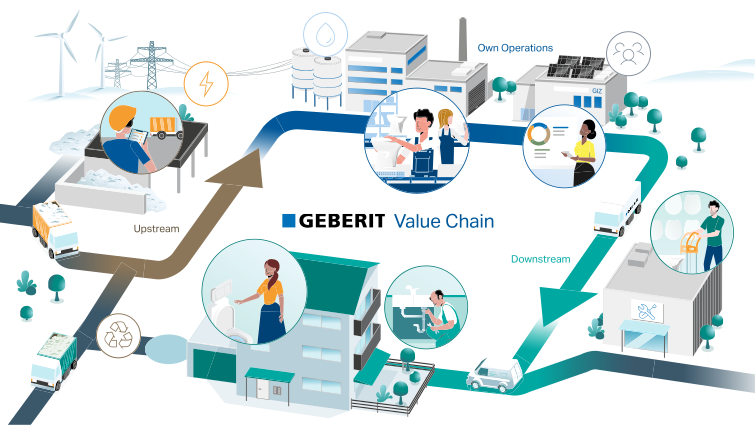
Impacts, risks and opportunities
The corporate culture – supplemented by the company-specific topic of antitrust legislation – was rated as material in the double materiality assessment. Impacts, risks and opportunities along the entire value chain were assessed, taking into account internal and external stakeholders. Existing due diligence processes were included here, such as for the detection of increased risks in terms of human rights and employment law in specific countries, business relationships or activities.
Two potential negative impacts, one risk and one opportunity were identified as material, whereby a relevance related to human rights was determined for both negative impacts.
The results of the materiality assessment were taken into account when revising key control instruments relating to business ethics – namely the Geberit Compass, Code of Conduct for Employees and Code of Conduct for Suppliers.
The identified impacts, risks and opportunities are listed below:
|
|
|
|
Time horizon |
|
Value chain |
||||||||
IRO description |
|
Type |
|
Short- |
|
Medium-term |
|
Long- |
|
Up- |
|
Own operations |
|
Downstream |
A lack of care in adhering to ethical and social standards increases susceptibility to violations in own operations and in relationships with others. |
|
Negative impact, potential |
|
|
|
|
|
|
|
|
|
|
|
|
A lack of care in adhering to ethical and social standards can lead to increased susceptibility to violations in the supply chain and impact the working conditions of the employees. |
|
Negative impact, potential |
|
|
|
|
|
|
|
|
|
|
|
|
A good, value-based corporate culture has a positive impact on productivity, low fluctuation, and the number of ill employees. |
|
Opportunity, potential |
|
|
|
|
|
|
|
|
|
|
|
|
Non-compliance with competition law or antitrust legislation can lead to material and non-material consequences (fines, damages, legal consequences, damage to the company’s reputation). |
|
Risk, potential |
|
|
|
|
|
|
|
|
|
|
|
|

Management system
Geberit sees an ethically based corporate culture as the foundation for sustainable value creation. Business ethics and corporate culture are the responsibility of the Board of Directors (responsible for the overall strategy) and the Group Executive Board (responsible for implementation).
Specialist departments support the Group Executive Board in implementing and controlling the measures in the following areas:
Corporate Human Resources: fundamental human and employee rights
Corporate Purchasing: supply chain laws and implementation of due diligence obligations in the supply chain
Corporate Legal Services: antitrust legislation, preventing corruption and data protection
Relevant internal and external stakeholders are also systematically involved in addressing strategic issues.
A holistic, decentralised compliance system ensures adherence to the agreed standards, norms and laws. The findings from risk analyses, compliance processes and audits form the basis for the annual Compliance Report submitted to the Board of Directors and the Group Executive Board, and are published in the sustainability report as part of the consolidated annual report. They are also included in the further development of guidelines on culture and ethics. The compliance organisation was last audited in 2021 by the auditing company KPMG.
Strategies and policies
The following guidelines and directives are used as a framework for the management of ethics and culture throughout the entire company and in its sphere of influence along the value chain:
Geberit Compass
Goal: The Geberit Compass forms the framework for correct conduct and is the central pillar of corporate culture. It defines four binding company values (integrity, modesty, collaboration, accountability) and six leadership principles (focus, decisiveness, performance, empowerment, resilience, communication).
Target group: All employees worldwide.
Relation to identified impacts, risks and opportunities: The Geberit Compass addresses the identified potential impacts, risks and opportunities with regard to ethical behaviour.
The Compass is reviewed annually as part of the strategy process. The current version was fully revised in 2025 with the involvement of internal specialist departments.
Geberit Code of Conduct for Employees
Goal: The Geberit Code of Conduct lays down binding rules on the conduct expected from employees, both inside and outside a business context. As a result, it serves as a guide for ethical, environmentally friendly and socially responsible business practices. The Code of Conduct for Employees is based on the International Bill of Human Rights, the UN Guiding Principles on Business and Human Rights, the ILO core labour standards and the principles of the UN Global Compact (UNGC).
Target group: All employees worldwide, indirectly: business partners.
Relation to identified impacts, risks and opportunities: The Code is the central instrument for preventing risks such as discrimination, human rights violations including child and forced labour, violations of rights at work, corruption, occupational health and safety violations, and for ensuring the protection of intellectual property, data protection, environmental protection and competition law. As a result, the Code directly addresses the potential impacts, risks and opportunities identified in the materiality assessment in the area of corporate culture and antitrust legislation. The Code of Conduct is reviewed annually and developed systematically. The current version was fully revised in 2025 with the involvement of internal specialist departments and employees from a variety of business areas.
Antitrust Law Guideline
Goal: The Antitrust Law Guideline takes the obligation of all companies to adhere to applicable laws as detailed in the Geberit Code of Conduct and supplements it with practical specifications and explanations. This guideline ensures that the relevant employees are familiar with the most important antitrust regulations, helps to assess relevant circumstances relating to antitrust law correctly, and act with fair competition in mind.
Target group: Middle and upper management and first-line sales managers at the European sales companies.
Relation to identified impacts, risks and opportunities: The Antitrust Law Guideline directly addresses the risks that could occur as a result of non-compliance with antitrust law (e. g. anticompetitive market distortions, damage to the company’s reputation, fines).
Guideline for donations to and from business partners of the Geberit Group (Donation Guideline)
Goal: The Donation Guideline substantiates the rules of conduct on preventing corruption defined in the Geberit Code of Conduct. It offers employees clear behavioural guidelines on how to handle gifts and invitations and helps them to consistently maintain ethical standards.
Target group: Employees in all Geberit Group companies.
Relation to identified impacts, risks and opportunities: Geberit produces and sells large numbers of standardised single products mostly to wholesalers, meaning the risk of corruption is considered as low. This assessment is confirmed both by internal risk analyses and the materiality assessment. The Donation Guideline helps to prevent potential misconduct.
Data Protection Guideline
Goal: The Data Protection Guideline defines the structure of the in-house data protection organisation at Geberit and creates a uniform, binding framework for the legally compliant handling of personal data according to the General Data Protection Regulation (GDPR).
Target group: Employees in all GDPR-relevant Geberit Group companies (those based in the EEA, Switzerland and Great Britain).
Relation to identified impacts, risks and opportunities: The Data Protection Guideline serves as the central policy of the Geberit Group on GDPR compliance and the protection of personal data. Although these risks were not identified as material, the Data Protection Guideline addresses the potential risks in connection with data misuse and the loss of reputation.
Data Protection Framework Agreement
Goal: The Data Protection Framework Agreement defines uniform data protection principles and reporting obligations in the event of data breaches also for companies outside the scope of the GDPR, and thus supplements the corresponding legislation with central principles. As the basis for exchanging personal data, the Data Protection Framework Agreement contains the legally necessary data processing agreements, agreements for joint controllership and the applicable standard contractual clauses.
Target group: Employees in all Geberit Group companies.
Relation to identified impacts, risks and opportunities: The Data Protection Framework Agreement forms the basis for the exchange of personal data across companies. Although these risks were not identified as material, potential risks in connection with data misuse and the loss of reputation are addressed.
Code of Conduct for Suppliers and Business Partners
Goal: The Code of Conduct for Suppliers and Business Partners defines the requirements for human rights and rights at work, working conditions, environmental protection and ethical behaviour in the supply chain. The Code is based on national and international directives, particularly the International Bill of Human Rights, the UN Guiding Principles on Business and Human Rights, the ILO core labour standards, the principles of the UN Global Compact (UNGC) and the OECD Guidelines for Multinational Enterprises.
Target group: All suppliers and business partners.
Relation to identified impacts, risks and opportunities: In particular, the Code addresses risks in relation to human rights violations, child and forced labour, bribery and corruption, plus potential violations of applicable environmental and social standards in the supply chain.
The Code of Conduct for Suppliers and Business Partners was fully revised in 2025.
Policy Statement on Human Rights
Goal: The Policy Statement on Human Rights reinforces Geberit’s responsibility to adhere to internationally recognised human rights along the entire value chain. It is based on principles detailed in the Code of Conduct for Employees and makes reference to the International Bill of Human Rights, the UN Guiding Principles on Business and Human Rights, the ILO core labour standards and the principles of the UN Global Compact (UNGC).
Target group: All internal functions related to the supply chain, particularly Corporate HR and Corporate Purchasing.
Relation to identified impacts, risks and opportunities: The Declaration addresses potential risks relating to human rights. It defines the responsibilities, processes and instruments for risk analysis, prevention, and also correction and complaint mechanisms.
General terms and conditions of purchase (GTCP) at the Geberit Group
Goal: The General terms and conditions of purchase (version 2024) define legally binding requirements on adherence to contracts, compliance, confidentiality and ethical behaviour.
Target group: Suppliers of the Geberit Group.
Relation to identified impacts, risks and opportunities: The GTCP ensure that the rights of third parties, compliance requirements and integrity requirements are contractually safeguarded and can be sanctioned in the event of violations.
Geberit follows a holistic governance approach that incorporates directives, processes, training and controls in such a way that correct conduct is promoted, ethical risks are minimised and the opportunities offered by a strong corporate culture are realised. In addition to the aforementioned guidelines and directives, the effectiveness of the management system is supported in particular by clear responsibilities and KPI-based control processes.
Processes, measures and controls
Geberit reinforces the value-based corporate culture with clearly structured processes, targeted training and effective complaint and control mechanisms. These control instruments ensure that specifications relating to business ethics are adhered to and counteract misconduct. Interdisciplinary instruments include the following:
Mandatory onboarding content for all new employees (preventing corruption, discrimination and bullying, plus compliance with data protection for employees in GDPR-relevant roles).
Training courses: Specific eLearning courses for all employees (e. g. on discrimination and bullying), refresher training for specific target groups (preventing corruption, data protection).
Monitoring: Systematic monitoring of implementation.
Integration in management tools such as assessment instruments, target agreements and bonus mechanisms.
Communication and raising awareness: Regular reports via Intranet and employee magazine “360°”, events, internal communication campaigns.
Controls: Audits by Corporate Internal Audit, third-party EHS audits, supplier audits, data protection audits.
Comprehensive annual compliance review at all companies and on-site audits by Corporate Internal Audit.
Central reporting systems: Geberit Integrity Line (for employees) and Supplier Integrity Line (for business partners), which meet the requirements of the EU Whistleblower Directive and ensure anonymity and protection against reprisals.
Reporting: Quarterly reports to the Group Executive Board and annual sustainability report, which includes training quotas, audit results, cases reported to the Integrity Line and any sanctions.
In addition to the overarching measures, guideline-specific instruments are used to establish and develop the respective guidelines and directives, to prevent misconduct and for control purposes:
Geberit Code of Conduct for Employees
The Geberit Code of Conduct is binding across the Group. New employees complete a mandatory eLearning course on relevant topics (e. g. preventing corruption and bribery, data protection, discrimination and bullying) within 30 days of joining the company. Employees in high-risk roles in purchasing, marketing and sales and project management receive annual in-depth training.
The launch of the revised Code of Conduct in the reporting year was accompanied by a range of internal communication measures.
The effectiveness of the Code is ensured by the following control instruments:
The Geberit Integrity Line as an anonymous whistleblower hotline.
Integration of key figures in assessment instruments, target agreements and bonus mechanisms.
Annual monitoring of implementation in all Group companies via Code of Conduct reporting (structured questionnaire containing 58 questions), supplemented by interviews with the managing directors of the individual companies.
Audit tool and ISO certifications: Digital tools for audit management. Geberit has a Group certificate in accordance with ISO 9001 (quality), ISO 14001 (environment) and ISO 45001 (occupational health and safety) that is valid until 2027, which additionally reinforces quality and cultural standards.
Risk-based audits by Corporate Internal Audit including interviews with the managing directors of the individual companies.
Non-compliance with the Code of Conduct will be systematically sanctioned. Responsibility lies with the respective HR department on a local level and Corporate HR. Corrective measures range from internal investigations and training, all the way through to contractual adjustments or termination of the employment relationship.
The findings from the Code of Conduct reporting and audits form the basis for the annual Compliance Report submitted to the Board of Directors and the Group Executive Board, and are published in the sustainability report.
Geberit Integrity Line for Employees
The Geberit Integrity Line is an integral part of the control system for uncovering and processing violations in the areas of ethics, discrimination, human rights and rights at work, corruption, competition law and data protection. Geberit offers various Integrity Lines – one from the Geberit Group that complies with the EU Whistleblower Directive and national laws adopted to implement it, and additional local Integrity Lines (NL, PT, SE, BE, PL, SL, IT). In terms of function and design, the local Integrity Lines follow the requirements of the EU Whistleblower Directive and national legislations.
The Geberit Integrity Line is available to all employees worldwide, is anonymous, multi-lingual and available 24/7 by phone and online. It is operated by an external service provider and offers whistleblowers reliable protection against reprisals. Reports received via the Integrity Line of the Geberit Group are forwarded to the Head Corporate Human Resources and Head Corporate Communications. The respective responsible member of the Group Executive Board is involved in the processing of each individual case.
Antitrust Law Guideline
In addition to the overarching measures that are applied for all aspects of business ethics (mandatory onboarding with training on the Code of Conduct, annual monitoring, communication measures, etc.), specific instruments relating to antitrust law are used to prevent misconduct and for control purposes:
eLearning “Geberit Compliance in Antitrust”: Determining the basics of antitrust legislation; for all management positions across the Group, plus all employees in European sales companies with antitrust-relevant customer contact; mandatory within 30 days of joining the company.
eLearning “Refresher”: In-depth teaching of knowledge relating to antitrust legislation using specific case studies; mandatory every 12 months for all management positions at the European sales companies and Group management.
Event-specific and in-depth training courses: Individual, needs-based training at individual companies, plus for new employees starting in middle or upper management.
Event-specific presentations at sales meetings for middle and upper management at the European sales companies; close communication between Corporate Legal Services and the managing directors of the production and sales companies, plus first-line sales managers.
Adherence to antitrust law specifications is an integral part of the Group-wide compliance system. In addition to Code of Conduct reporting as a central monitoring and control instrument, the sales companies are comprehensively audited every five years, or in shorter intervals where appropriate. Non-compliance will be systematically and comprehensively addressed and sanctioned. Corrective measures range from internal investigations and training, all the way through to termination of the contractual relationship.
Donation Guideline
The Donation Guideline specifies clear behavioural guidelines on how to handle gifts, invitations and other benefits. The permissible framework for donations and specific limits are clearly defined. Additionally, adherence to the principles is supported by training courses, internal communication and the Geberit Integrity Line as an anonymous whistleblower system. Adherence to the Donation Guideline is checked at all companies via the annual Code of Conduct reporting. Additionally, surveys on how donations are handled are carried out at the companies at irregular intervals. The topic of donations is also taken into account as part of internal audits and spot checks. Non-compliance will be systematically reviewed and sanctioned with suitable measures.
Data Protection Guideline
The Data Protection Guideline is implemented via a data protection management system (DPMS). Among others, this includes risk assessments, internal and external audits, clearly defined roles and responsibilities (data protection manager and local coordinators) and central documentation. Audits are conducted according to a rolling five-year plan and are supplemented by systematic tracking of remediation measures. Data breaches must be reported to the data protection manager within 24 hours. New employees at companies where the GDPR is in effect receive training on data protection as part of the onboarding process; this is repeated every two years.
Management of supplier relationships
In procurement, Geberit reinforces environmental, social and governance aspects (ESG) in all processes. The “Total Value of Ownership” strategy has taken environmental, human rights and social criteria into account since 2021. Responsibility lies with the lead buyers for individual material groups. New employees are introduced to sustainable procurement principles, with regular in-depth training for lead buyers. ESG aspects are included in the annual supplier assessment.
Supplier management includes risk management on the environment, occupational safety, human rights and conflict minerals according to Art. 964a ff. of the Swiss Code of Obligations and the ESRS requirements relating to corporate due diligence obligations. The risk-based assessment of all suppliers is made according to country, material group and other criteria such as quality, price, social and environmental criteria and delivery reliability. The classification is reviewed annually. Particularly at-risk partners undergo tighter EHS and human rights audits carried out with external auditors.
According to the sustainability strategy, Geberit’s aim is for 90% of direct suppliers with recurring business and a procurement spend of more than CHF 50,000 per year to have improved their ESG risk profile to at least “medium”. The goal supports the targeted reduction of ESG risks along the supply chain and gives a guideline for prioritising measures in supplier management.
The risk-based classification (low, medium, high) is based on an analysis of risks by country and material group:
Risk by country: The assessment is based on four public sources. A score below 50 in the Corruption Perceptions Index (CPI) of Transparency International or an increased risk classification in the Children’s Rights in the Workplace Index of UNICEF result in classification as a high-risk country. A high number of non-ratified basic ILO agreements further increases the risk. This also applies to countries classified as a Least Developed Country or Low Income Country by the OECD.
Risk by material group: This takes into account environmental relevance (e. g. air and water emissions, waste) and the energy requirements in the respective production process. Additionally, the incident potential and risk potential in the area of occupational safety are systematically assessed.
The ESG risk in the supply chain is low due to the predominantly Western European supply sources, which was also confirmed by the materiality assessment. Conflict minerals (tin, tantalum, tungsten, gold) are not imported or processed in the EU or Switzerland. As a result, Geberit is not deemed to be an “importer” within the meaning of EU Regulation 2017/821 or Art. 964a ff. of the Swiss Code of Obligations.
At the heart of the management system for supplier relationships is a Code of Conduct for Suppliers and Business Partners, which is available in 15 languages. This requires that suppliers and business partners comply with comprehensive standards relating to the environment, human rights and employment law. A new, comprehensive version of the Code of Conduct for Suppliers and Business Partners was launched in the reporting year. The Code is accompanied by applicable control instruments in the area of supplier management:
Training and raising awareness: All employees at the sales organisation complete web-based training on the German Supply Chain Act and human rights obligations.
Follow-ups to supplier audits: Results from the audits are included in a binding programme of corrective measures. Corrective measures are systematically tracked; serious or repeat violations can result in termination of the contract.
ESG ratings: Geberit takes part in the EcoVadis rating each year and publishes the assessment of its sustainability management. Geberit is currently ranked in the 94th percentile of over 150,000 rated companies.
Ongoing projects on CO2 data transparency and alternative materials aim to further reduce the Scope 3 footprint. The CO2 data of imported goods is inspected in relation to the EU Carbon Border Adjustment Mechanism (CBAM).
Non-compliance with the Code of Conduct for Suppliers and Business Partners will be systematically sanctioned. Responsibility lies with Corporate Purchasing. Corrective measures range from selective adjustments, training and re-audits through to termination of the business relationship.
Supplier Integrity Line
An anonymous reporting channel for external business partners has been in place since 2017. The Supplier Integrity Line is part of the control system for uncovering and processing violations against social, environmental and compliance standards in the supply chain that are agreed in the Code of Conduct for Suppliers and Business Partners. It meets EU whistleblower requirements and is available to all external partners worldwide, is anonymous, multi-lingual and available 24/7. The platform is operated by an external service provider and offers whistleblowers reliable protection against reprisals. Reports received via the Supplier Integrity Line are forwarded to the Head Corporate Purchasing and Head Corporate Human Resources. The respective responsible member of the Group Executive Board is involved in the processing of each individual case. The reports and results of any investigations are included in the annual supplier assessment. These can result in sanctions, all the way through to termination of the contract.
Measures and key figures in the reporting year
Own business area
The Geberit Compass and Geberit Code of Conduct were fully revised and relaunched in the reporting year. The launch was accompanied by comprehensive internal communication measures – from presentations for Group management and information events through to digital formats and publications. Both documents are publicly accessible. As part of the revision, the monitoring instrument – the questionnaire on Code of Conduct reporting – was also adapted. In addition, internal audits with compliance reviews took place at 19 companies of the Geberit Group in the reporting year. No violations or suspicions of cases were reported via the Geberit Integrity Line for employees in the reporting year.
|
|
2025 |
|
2024 |
|---|---|---|---|---|
Audited Geberit entities (internal audit) |
|
19 |
|
19 |
Cases reported via the Geberit Integrity Line |
|
0 |
|
2 |
Violations of occupational health & safety / environmental regulations |
|
0 |
|
1 fine |
Human rights
According to the annual Group-wide survey of the Code of Conduct, there were no cases of child, forced or compulsory labour recorded in 2025.
However, seven cases of sexual harassment were reported. Two individuals were dismissed following internal investigations, two individuals decided to leave the company while internal investigations were ongoing, and three others were issued with disciplinary warnings. There were no reports of bullying or discrimination.
|
|
2025 |
|
2024 |
|---|---|---|---|---|
Identified cases of child labour in own operations |
|
0 |
|
0 |
Identified cases of forced or compulsory labour in own operations |
|
0 |
|
0 |
Severe human rights incidents in own operations |
|
0 |
|
0 |
Fines related to human rights incidents |
|
0 |
|
0 |
Discrimination and harassment cases |
|
7 |
|
5 |
Fines and compensation related to discrimination cases |
|
0 |
|
0 |
Data protection
The new eLearning course on data protection was carried out during the reporting year as planned for all employees with office workplaces in GDPR-relevant countries. There were no known complaints concerning violations of data protection relating to customers.
|
|
2025 |
|
2024 |
|---|---|---|---|---|
Participants in Data Protection eLearning programmes |
|
1,100 |
|
4,000 |
Participants in Advanced Data Protection trainings |
|
700 |
|
120 |
Internal data protection audits |
|
3 (FR, SI, FI) |
|
4 (PL, AT, HU, RO) |
Data protection breaches (notifiable) |
|
0 |
|
0 |
Customer complaints on data protection |
|
0 |
|
0 |
Antitrust legislation
No violations of embargo directives in connection with customer or supply chains were determined in the reporting year. An official investigation concerning competition law is pending. There were no other incidents in connection with non-compliance with antitrust legislation.
|
|
2025 |
|
2024 |
|---|---|---|---|---|
Antitrust trainings |
|
7 |
|
4 |
Reports via the Geberit Integrity Line relating to antitrust violations |
|
0 |
|
0 |
Internal antitrust audits |
|
4 (FI, FR, PL, BE) |
|
4 (AT, DE, Iberia, Adriatics) |
Confirmed antitrust violations |
|
0 |
|
0 |
Fines and penalties |
|
0 |
|
0 |
Anti-corruption
There were no indications of improper cash or non-cash benefits being made to public bodies, politicians, business partners or other parties.
|
|
2025 |
|
2024 |
|---|---|---|---|---|
Reports via the Geberit Integrity Line related to violations against the prohibition of corruption |
|
0 |
|
0 |
Internal anti-corruption audits |
|
19 |
|
19 |
Confirmed cases of corruption |
|
0 |
|
0 |
Fines and penalties |
|
0 |
|
0 |
Supply chain
The Code of Conduct for Suppliers and Business Partners was fully revised in the reporting year. Additionally, the Policy Statement on Human Rights was drawn up and launched. Both documents are available on the Geberit website.
The Code of Conduct for Suppliers and Business Partners is the central pillar for cooperation and is the main instrument used in the management of supplier relationships. 95% of the procurement spend for direct materials is covered through this binding guideline on conduct in line with business ethics.
|
|
|
|
Share of procurement spend |
|
|
|
Share of procurement spend |
||||||
|---|---|---|---|---|---|---|---|---|---|---|---|---|---|---|
|
|
2025 |
|
% |
|
2024 |
|
% |
||||||
Number of direct suppliers* |
|
1,404 |
|
n.a. |
|
1,481 |
|
n.a. |
||||||
Suppliers classified as high-risk |
|
154 |
|
6.0 |
|
157 |
|
7.0 |
||||||
Direct and indirect suppliers with a signed Code of Conduct for Suppliers and Business Partners |
|
5,075 |
|
> 95 |
|
4,550 |
|
> 95 |
||||||
Third-party audits** |
|
10 |
|
n.a. |
|
7 |
|
n.a. |
||||||
Third-party audits - findings |
|
47 |
|
n.a. |
|
58 |
|
n.a. |
||||||
Reports via the Supplier Integrity Line |
|
0 |
|
n.a. |
|
0 |
|
n.a. |
||||||
Cases of child labour in the supply chain |
|
0 |
|
n.a. |
|
0 |
|
n.a. |
||||||
Cases of forced or compulsory labour in the supply chain |
|
0 |
|
n.a. |
|
0 |
|
n.a. |
||||||
|
||||||||||||||
In 2025, 154 suppliers (previous year 157) were identified in the highest risk category, which corresponds to 6% (previous year 7%) of the direct procurement spend. Of the suppliers in this risk category with an annual procurement spend of over CHF 50,000, all suppliers have signed the Code of Conduct for Suppliers and Business Partners.
Ten audits were carried out by external partners at suppliers with increased risk in China, India and Romania. The most important obligations in the Code of Conduct and the due diligence obligations related to human rights, social aspects and the environment were complied with; appropriate corrective measures were agreed in cases of non-compliance. The business relationship with one supplier was terminated. Most of these cases related to deficiencies in occupational safety, the insufficient recording and documentation of hours worked and complaints regarding remuneration practices. In terms of environmental standards, a total of four additional findings of minor significance were recorded. Implementation of the agreed corrective measures is checked and documented promptly by Geberit.
There were no cases of child, forced or compulsory labour revealed as part of the audits. No reports were received via the Supplier Integrity Line.