

6. Remuneration architecture for the Group Executive Board
The remuneration of the GEB is defined in a regulation adopted by the BoD and consists of the following elements:
Base salary
Variable remuneration
Short-Term Participation (STP)
Long-Term Participation (LTP)
Additional employee benefits, such as pension benefits and perquisites
|
|
Programme |
|
Instrument |
|
Purpose |
|
Plan/ |
|
Performance metrics |
|---|---|---|---|---|---|---|---|---|---|---|
Base salary |
|
Annual base salary |
|
Monthly cash payments |
|
Pay for the function |
|
|
|
|
Short-Term Participation, STP |
|
Short-Term Participation, STP |
|
Annual variable cash or restricted shares |
|
Drive and reward |
|
1-year performance period |
|
Sales growth, EBITDA margin, EPS growth, ROIC, |
|
Share Participation Programme (MSPP) |
|
Matching share options in case of an investment of STP in restricted shares, performance share options (free of charge) |
|
Align with shareholders’ interests |
|
Shares: |
|
Share options: ROIC |
|
|
|
|
|
|
|
|
Share options: |
|
|
|
Long-Term Participation, LTP |
|
Share Option Programme (MSOP) |
|
Performance share options |
|
Drive and reward |
|
3-year performance period, 10-year plan period |
|
ROIC |
Benefits |
|
Pension |
|
Swiss pension funds (Gemeinschaftsstiftung/ |
|
Cover retirement, death and disability risks |
|
|
|
|
|
Perquisites |
|
Company car, |
|
Attract and retain |
|
|
|
|
6.1 Annual base salary
The annual base salary is a fixed remuneration paid in cash on a monthly basis. It is determined based on the scope and responsibilities of the position, the market value of the role and the qualifications and experience of the incumbent. The base salary is reviewed annually based on market salary information, considerations from the perspective of the company’s financial affordability and performance, and the evolving experience of the individual in the role.
6.2 Short-Term Participation programme (STP)
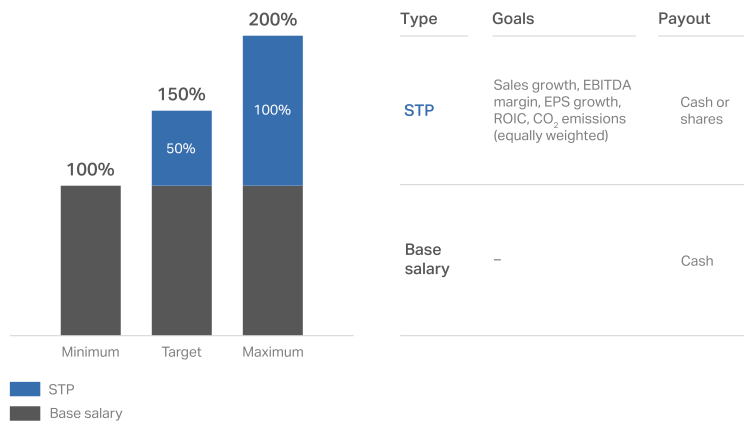
The STP is a target-based variable remuneration designed to reward the annual performance and is offered to the GEB members and approximately 220 additional members of the Group management. As previewed in the Remuneration Report 2024, as of financial year 2025, individual objectives are no longer reflected in the STP of the GEB members. For them, the STP is therefore fully based on group financial business goals, incl. sales growth, EBITDA margin, EPS growth, and ROIC as well as the ESG goal (CO2 emissions) which are all equally weighted. For employees below GEB, the STP will continue to additionally reflect individual objectives agreed and evaluated within the annual performance management process. The variable remuneration award is delivered in cash. Members of the GEB have the opportunity to invest part or all of their award in blocked shares of the company through the Management Share Participation Programme (MSPP). Two free performance share options are allocated for each share purchased through the programme (see Management Share Participation Programme (MSPP)).
Target and maximum payout potential for the Group Executive Board
The STP target equals 50% of the annual base salary for the CEO as well as for other members of the GEB. The maximum potential payout for the STP is capped at 100% of the annual base salary, unchanged compared to previous years.
Remuneration structure Group Executive Board
Group financial business goals and ESG goal
The Group goals include equal weighting of four financial objectives and one ESG objective. Every year, based on the NCC’s recommendation, the BoD determines the expected target level for each financial and ESG goal for the following year. Geberit wants to reinforce its position as market leader and consistently achieve above-average performance. As a general principle, targets are set considering the current market environment, the business situation, and the mid-term goal to grow above the market. The intention of this demanding target setting is to deliver best-in-class performance and to stay ahead of the market. In addition, a threshold level of performance, below which no variable remuneration is paid out, and a maximum level of performance, above which the short-term variable remuneration is capped, are determined. The payout level between the threshold, the target and the maximum is calculated by linear interpolation. The maximum payout potential for maximum level of performance is capped at double the target level for each goal as well as for the total.
The target levels for each financial goal are set according to budget. The budget is ambitious and reflects the actual market environment, includes the aspiration to strengthen the market position and takes into account the achievement of the medium-term goals.
Overview of Group financial and ESG goals
Group performance indicators |
|
Sales growth |
|
EPS growth |
|
EBITDA margin |
|
ROIC |
|
ESG |
|---|---|---|---|---|---|---|---|---|---|---|
Performance period |
|
Business year 2025 |
||||||||
Weighting (percentage of the STP target) |
|
20% |
|
20% |
|
20% |
|
20% |
|
20% |
Purpose |
|
Reward for business growth and market share gains |
|
Reward for the increase in profitability on a per-share basis |
|
Reward for the increase in profitability from operations |
|
Reward for the increase in efficiency of the use of capital to generate returns |
|
Reward for the contribution to climate change mitigation |
Measurement |
|
Organic, currency-adjusted year-on-year net sales growth |
|
Year-on-year growth of earnings per share in CHF |
|
Earnings before interest, taxes, depreciation and amortisation (EBITDA) as a percentage of net sales |
|
Return on invested capital (net operating profit after tax/invested capital) |
|
Reduction in |
Management Share Participation Programme (MSPP)
Members of the GEB have the opportunity to invest part or all of their STP award in shares of the company through the MSPP. They may define a fixed number of shares to purchase, or a certain amount or a percentage of their STP award to be invested in shares. The shares are blocked for a period of three years. Two free share options are allocated for each share purchased through the programme. The share options are subject to the same performance-based vesting conditions as those applicable to the performance options granted under the Long-Term Participation MSOP programme (see also 6.3 Long-Term Participation programme (LTP)).
In the event of termination of employment, the following provisions apply to MSPP shares and options:
Termination reason |
|
Plan rules |
|
|
|
|
||||||||
|---|---|---|---|---|---|---|---|---|---|---|---|---|---|---|
|
|
|
|
Unvested options |
|
Vested options |
|
Restricted shares |
||||||
Good leaver |
|
Retirement benefits |
|
Regular full vesting based on effective performance at regular vesting date |
|
Regular exercise period |
|
Regular blocking period |
||||||
|
Invalidity |
|
|
|
||||||||||
|
Other reasons |
|
|
|
||||||||||
|
Liquidation/ |
|
Accelerated full vesting based on effective performance at date of termination as determined by the BoD |
|
|
Immediate unblocking |
||||||||
|
Death |
|
Accelerated full vesting |
|
|
|||||||||
Bad leaver |
|
Inadequate performance/ |
|
Forfeiture |
|
Regular exercise period |
|
Regular blocking period |
||||||
|
||||||||||||||
6.3 Long-Term Participation programme (LTP)
The LTP is a performance stock option programme (the Management Stock Option Programme: MSOP) vesting after three years, conditionally upon fulfilling a performance condition, the ROIC. It is designed to retain the members of the GEB and Group management participants in the long term, reward them for long-term value creation, and to align their interest with those of the shareholders.
In response to feedback from some shareholders and proxy advisors regarding the use of ROIC as the sole metric in the LTP without any relative performance measures, the BoD conducted a comprehensive review in 2025 to assess whether to replace or supplement ROIC with a relative performance indicator. After thorough consideration, the BoD concluded that ROIC should remain as a performance metric in the LTP. The BoD views ROIC as a key driver of Geberit’s value creation, given its strong effectiveness in measuring capital allocation efficiency. As such, it closely aligns management’s interests with sustainable, long-term decision-making. While relative Total Shareholder Return (TSR) was considered as a potential additional performance measure, it was ultimately not used given that performance stock options are already closely aligned with share price development and the interest of shareholders. The BoD also evaluated discontinuing the use of ROIC in the STP to prevent an overlapping performance measurement between both incentive plans. However, it was decided that due to its strategic importance, ROIC should continue to be included in both the STP and LTP, as it remains operationally relevant for achieving annual targets while also serving as a critical metric for long-term capital allocation decisions. The LTP target is reviewed annually. In 2025, the BoD approved an adjustment to the target pay mix for the CEO, including an increase of the target LTP to 135% of the annual base salary (2024: 125%). For the other members of the GEB, the target LTP was increased to 80% of their respective annual base salary (2024: 70%). These changes were made to further emphasise the long-term focus of the GEB members’ remuneration. For some 190 additional participants of Group management, the fair value at allocation date amounted to 5%, 10% or 15% of the base salary, depending on the level of the role, and thus remains unchanged.
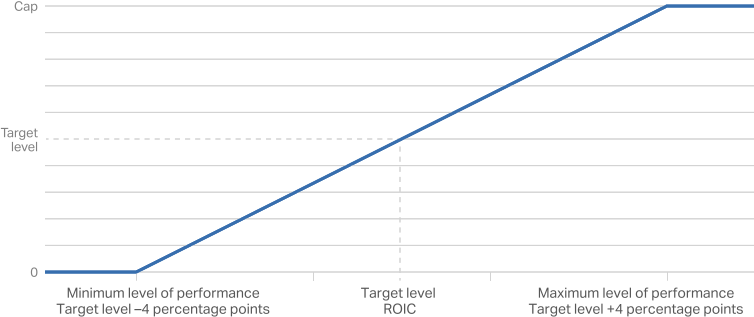
At the beginning of the vesting period, a number of performance stock options are allocated to each participant. The target ROIC and the performance corridor is set at the beginning of the performance period by the BoD on the recommendation of the NCC and is measured at the end of the performance period as the average over the three years. The target level and the cap are set at an ambitious level, well above the weighted average cost of capital. The payout curve is challenging to ensure full vesting rewards outstanding performance. For performance below the minimum threshold, no options vest, whereas for performance at the target level, 50% of the allocated options vest. Outperformance is rewarded up to a maximum of 100% vesting (cap) of the allocated options, which is equivalent to twice the target LTP. The number of options vesting between the minimum threshold and the cap is determined by linear interpolation.
The options can be exercised between the vesting date, which is three years after the grant date, and the expiry date, which is seven years after the vesting date. The exercise price of the options corresponds to the fair market value of the Geberit shares at the time of allocating.
The elements of the 2025 MSOP are outlined below:
|
|
CEO |
|
GEB Members |
|---|---|---|---|---|
2025 LTP target as % of the annual base salary |
|
135% |
|
80% |
LTP vesting opportunity as a percentage of the target LTP |
|
0%–200% |
|
0%–200% |
LTP vesting opportunity as a percentage of the annual base salary |
|
0%–270% |
|
0%–160% |
Performance period |
|
2025–2027 |
|
|
Performance indicator |
|
Return On Invested Capital (ROIC) |
||
Purpose |
|
Expresses the efficiency of the use of capital to generate returns. |
||
Definition |
|
Average over the |
||
Performance vesting |
|
|
||
Vesting and holding periods |
|
3-year vesting period |
||
Termination conditions
In the event of termination of employment, the following provisions apply to MSOP options:
Termination reason |
|
Plan rules |
|
|
||||||||||
|---|---|---|---|---|---|---|---|---|---|---|---|---|---|---|
|
|
|
|
Unvested options |
|
Vested options |
||||||||
Good leaver |
|
Retirement benefits |
|
Pro-rata vesting based on effective performance at regular vesting date1 |
|
Regular exercise period |
||||||||
|
Invalidity |
|
|
|||||||||||
|
Other reasons |
|
|
|||||||||||
|
Liquidation/change of control2 |
|
Accelerated full vesting based on effective performance at date of termination as determined by the BoD |
|
||||||||||
|
Death |
|
Accelerated full vesting |
|
||||||||||
Bad leaver |
|
Inadequate performance/inadequate conduct3 |
|
Forfeiture |
|
Regular exercise period |
||||||||
|
||||||||||||||
6.4 Disclosure of targets
Geberit does not have any publicly listed competitors that are active in all its business segments. Geberit’s segment competitors are mostly privately held and disclose very limited financial and performance information. Disclosing forward-looking targets on commercially sensitive information would place Geberit at a competitive disadvantage and ultimately not serve the best interests of our shareholders. Therefore, the decision was made not to disclose the specifics of those targets at the time of their setting, but to provide relevant performance achievements and the resulting payout factors at the end of the cycle. The targets are set in line with the ambition to achieve the medium-term goals which are regularly communicated to shareholders.
See also 8. Remuneration awarded to the Group Executive Board and share ownership in 2025.
6.5 Clawback and malus provisions
In order to ensure good corporate governance, Geberit has implemented a clawback policy on payments made under the STP and the LTP. These provisions foresee that in case of financial restatement due to non-compliance with accounting standards and/or fraud, and/or in case of violation of the law or internal rules by a participant, the BoD may deem all or part of any unpaid short-term participation award or unvested long-term share options to be forfeited (malus provision) and/or may seek reimbursement of all or part of any paid short-term participation award or vested long-term share options (clawback policy). The clawback and malus provisions may be enacted for a period of three years following the year subject to a financial restatement and/or the year of the fraudulent behaviour.
6.6 Share ownership guidelines
In order to bring the interests of the members of the GEB into line with those of the shareholders and to strengthen their ties to the company, the CEO and each member of the GEB must satisfy the minimum requirements with respect to the ownership of shares in Geberit. The members of the GEB are required to build up and own at least a minimum multiple of their annual base salary in Geberit shares within five years of their appointment to the GEB or introduction of this policy, as set out below.
The minimum shareholding requirements for the GEB members remain unchanged:
CEO
300% of the annual base salary
Members of the GEB
150% of the annual base salary
For this calculation, all vested shares are considered, regardless of whether they are blocked or not. However, unvested awards are excluded. The NCC reviews compliance with the share ownership guideline on an annual basis.
As of year-end 2025, the GEB members comply with the respective ownership guidelines. The CEO holds the equivalent of 18.8 times his annual base salary in Geberit shares, and the other GEB members hold on average 4.5 times their annual base salary in Geberit shares.
The shareholding of the GEB is presented in 10. Summary of shares and options held by the Board of Directors, Group Executive Board and Employees.
6.7 Pension and benefits
Members of the GEB participate in the regular employee pension fund applicable to all employees in Switzerland. The retirement plan consists of a basic plan covering annual earnings up to TCHF 159, with age-related contribution rates shared between the company and the individual, and a supplementary plan (collective foundation in accordance with Art. 1e BVV 2 [Ordinance on Occupational Retirement, Surviving Dependants’ and Disability Pension Plans]) in which income in excess of TCHF 159 is insured (including actual variable remuneration), up to the maximum amount permitted by law.
Furthermore, each member of the GEB is entitled to a company car and a representation allowance in line with the expense regulations applicable to all members of management in Switzerland and approved by the tax authorities.
6.8 Employment terms and conditions
All members of the GEB have permanent employment contracts with notice periods of a maximum of one year. Members of the GEB are not entitled to any severance payment.
The employment contracts of the GEB members may include post-employment non-competition clauses for a duration of eighteen months. In case the company decides to activate the post-employment non-competition provisions, the compensation paid may not exceed 50% of the last annual cash compensation (annual base salary and STP).