

Employees in the value chain
Overview

The significance of the topic along the value chain
Trainings
Impacts, risks and opportunities
The risk profile of the value chain in terms of social risks is relatively low. This classification is the result of short supply chains, high production depth, a very high share of Western European suppliers and predominantly European customers.
Correspondingly, no material human-rights related risks – in particular in relation to child or forced labour – were identified within the double materiality assessment. The issue of human rights is addressed in detail in the chapter Corporate culture and antitrust legislation.
On the other hand, three positive impacts in the area of “Training and further training for employees in the value chain” were identified and classified as material. This assessment has also been confirmed by internal and external stakeholders.
The identified material impacts, risks and opportunities are indicated below:
|
|
|
|
Time horizon |
|
Value chain |
||||||||
IRO description |
|
Type |
|
Short- |
|
Medium-term |
|
Long- |
|
Up- |
|
Own operations |
|
Downstream |
Employees are empowered to take on existing and new tasks; training measures lead to increased qualifications. |
|
Positive impact, actual |
|
|
|
|
|
|
|
|
|
|
|
|
The position of the employees on the job markets can be strengthened. |
|
Positive impact, actual |
|
|
|
|
|
|
|
|
|
|
|
|
Further development and training enhance the feeling of appreciation and contribute to satisfaction at the workplace. |
|
Positive impact, actual |
|
|
|
|
|
|
|
|
|
|
|
|

Management system
Strategic responsibility for due diligence obligations in the supply chain and for “Employees in the value chain” lies with the Board of Directors. It approves the relevant guidelines and checks their implementation at least once a year. Operational responsibility lies with the Group Executive Board, which is supported by specialist departments.
The following topics are the responsibility of the respective departments:
Corporate Purchasing: supply chain laws, implementation of due diligence obligations and fundamental human and employee rights
Corporate Training & Education: customer training
A holistic, decentralised compliance system ensures adherence to the agreed standards, norms and laws, see Corporate culture and antitrust legislation.
Strategies and policies
Geberit sees an ethical corporate culture as the core foundation for sustainable value creation. The company expects the business activity of its partners along the value chain to be correct in every respect, in the same way as the activity of its employees. Effective management of environmental and social criteria at suppliers and business partners helps to ensure compliance with laws as well as ethical, social and environmental standards.
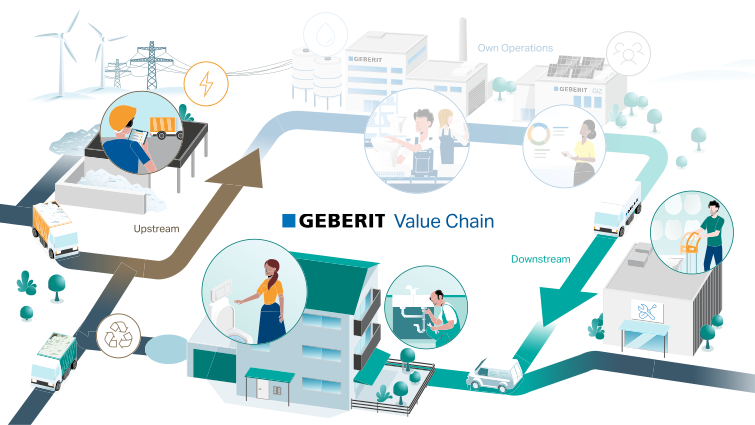
Geberit distinguishes between business partners according to their respective roles in the value chain, which it addresses through appropriate policies:
Upstream value chain: suppliers and transport companies
Geberit ensures compliance with ethical and social standards by establishing binding principles. These include the Code of Conduct for Suppliers and Business Partners and the Policy Statement on Human Rights according to the requirements of the German Supply Chain Act (Lieferkettensorgfaltspflichtengesetz, LkSG).
The Code of Conduct was fully revised in the reporting year. This included the perspectives of key stakeholders, including information obtained from supplier audits as well as feedback from the internal Procurement and Sustainability departments. In particular, the Code addresses risks in relation to human rights violations, child and forced labour, bribery and corruption, plus potential violations of environmental and employment law, as explained in detail in the chapter Corporate culture and antitrust legislation.
The Code of Conduct for Suppliers and Business Partners is binding for all direct suppliers. New suppliers must sign it as part of the onboarding process. In doing so, they are obliged to inform their employees regularly and in an appropriate manner concerning ESG-relevant topics – in particular occupational health and safety, human rights, ethical business conduct and environmental protection – and to provide training on these topics. In addition, Geberit expressly requires that the Code is passed on to subcontractors and is also implemented by them.
Downstream value chain: customers
A central element of Geberit’s corporate strategy is the sales model, which is based on close cooperation with customers. An integral part of this sales model is education and training for plumbers and sanitary engineers as well as for architects. This aims to promote both the development of expertise and quality assurance in practice as well as the prevention of potential risks, for example in relation to installation errors or occupational accidents.
In this way, the sales model addresses and reinforces the positive impacts identified along the downstream value chain.
Processes, measures and controls
Upstream value chain: suppliers and transport companies
Geberit relies on clear standards, systematic risk monitoring and targeted training in the downstream value chain in order to identify human rights, environmental and occupational risks in good time and minimise them.
Training for Corporate Purchasing
All employees at the Geberit sales organisation complete web-based training on the German Supply Chain Act and applicable due diligence obligations on human rights. This training enhances the necessary expertise with the aim of systematically identifying risks in the supply chain, reacting to them appropriately, and clearly and systematically communicating the corresponding requirements to suppliers. In doing so, it makes a key contribution to the effective implementation of the Geberit Code of Conduct for Suppliers and Business Partners.
IntegrityNext software
Corporate Purchasing uses “IntegrityNext” software in order to monitor and manage ESG risks at suppliers. This enables a structured, ongoing assessment of suppliers, supports the early recognition of potential risks or negative incidents, and provides relevant information concerning regulatory requirements. The combination of data-driven analysis and specialist expertise enhances the quality and efficiency of risk identification.
EHS audits and interviews
Corporate Purchasing and Corporate Sustainability regularly carry out “Environment, Health and Safety” (EHS) audits of suppliers in the highest risk category. The suppliers to be audited are selected according to a risk matrix. The audits monitor compliance with the Code of Conduct for Suppliers and Business Partners as well as local legal requirements in relation to the environment, occupational health and safety and human rights.
Interviews are carried out on site with employees at the suppliers in order to identify the actual working conditions along the value chain. The audits are carried out by an independent service provider; if discrepancies are identified, targeted corrective measures are taken and their implementation is monitored.
Supplier Integrity Line
Since 2017, a Supplier Integrity Line has been available to suppliers for anonymously reporting irregularities in the procurement process or non-compliance with the Code of Conduct for Suppliers. It is operated by an independent service provider. The reports and results of any investigations are included in the annual supplier assessment and can result in sanctions up to and including termination of the contract.
Downstream value chain: customers
Education, training and information formats make a major contribution to qualification of employees at customer companies and thus sustainable value creation. These strengthen the partnership with wholesalers, craftsmen and planning offices, and also ensure that Geberit’s products are installed properly. This reduces risks for both installers and users, and also supports high-quality work.
Training for plumbers and sanitary engineers
Plumbers and sanitary engineers receive practical training on products, tools, software tools and installation skills at 30 Geberit Information Centres in Europe and overseas. eLearning courses and installation videos are also available. In addition, the free customer service provides support to plumbers and sanitary engineers in the event of technical issues and practical challenges. These resources empower employees in the value chain to master new and existing tasks, enhance their professional qualifications and strengthen their position on the labour market.
Information, events and trade fairs
Counter days and local and digital events are organised in numerous markets – often together with wholesalers. These formats impart knowledge on new technologies and support the development of the branch. The training on offer is supplemented by extensive technical documentation, which provides all necessary information concerning safe and professional product installation and maintenance.
Supplier Integrity Line
Alongside customer service as a point for submitting complaints, the Supplier Integrity Line is also available to all customers via the company website, through which they can report incidents or concerns on a confidential basis.
The Group Executive Board is informed of the results of audits, training quotas, breaches and any sanctions in quarterly reports. Relevant key figures are published in the annual sustainability report.
Measures and key figures in the reporting year
Employees at suppliers
In 2025, Geberit procured raw materials, semi-finished products and finished products with a procurement value of CHF 852 million (previous year CHF 850 million) from 1,404 direct suppliers around the globe (previous year 1,481).
The “IntegrityNext” software for managing supplier relationships has been gradually implemented since mid-2025. It enables ESG compliance and risk management to be systematically managed and documented along the entire supply chain. The 200 most important direct suppliers were involved in the initial implementation phase. They account for more than 85% of the direct procurement spend. Suppliers from the existing risk matrix with an annual procurement spend of more than CHF 50,000 were also integrated.
New suppliers are systematically assessed as part of the onboarding process according to defined environmental and social criteria. Among others, the assessment covers environmental management, climate relevance, labour and human rights standards as well as compliance aspects. This ensures that potential impacts, risks and opportunities can be identified and managed at an early stage. In the reporting year, all newly incorporated suppliers falling within the area of application of the software were subject to a corresponding environmental and social assessment.
The existing risk matrix is due to be replaced by the new software by the end of 2026.
Employees at customer companies
In 2025, Geberit significantly stepped up its exchanges with employees at market partners. This is apparent in particular in the sharp increases in visitor numbers to customer events as well as higher attendance numbers at in-person training at the Geberit Information Centres, where Geberit reinforced specialist expertise and interpersonal dialogue.
|
|
2025 |
|
2024 |
||||
|---|---|---|---|---|---|---|---|---|
Number of information centres in Europe and overseas |
|
30 |
|
30 |
||||
Number of customers reached through in-person trainings at information centres |
|
87,850 |
|
70,000 |
||||
Number of customers reached through digital trainings |
|
20,170 |
|
23,000 |
||||
Number of customers reached through physical and digital customer events (information sessions) |
|
101,900 |
|
69,000 |
||||
|
||||||||
Definitions and calculation bases
Direct suppliers are suppliers that provide raw materials or components that are incorporated directly in the end product.
Training refers to measures for familiarising customers with how Geberit’s products and solutions are used. The focus lies on product training, which also addresses product safety and product sustainability among other topics. This is carried out at a Geberit Information Centre, at customers, at selected events, or digitally – for example as webinars and eLearning courses.
Geberit relies on primary data from data recording systems found within the Group.