Strategy
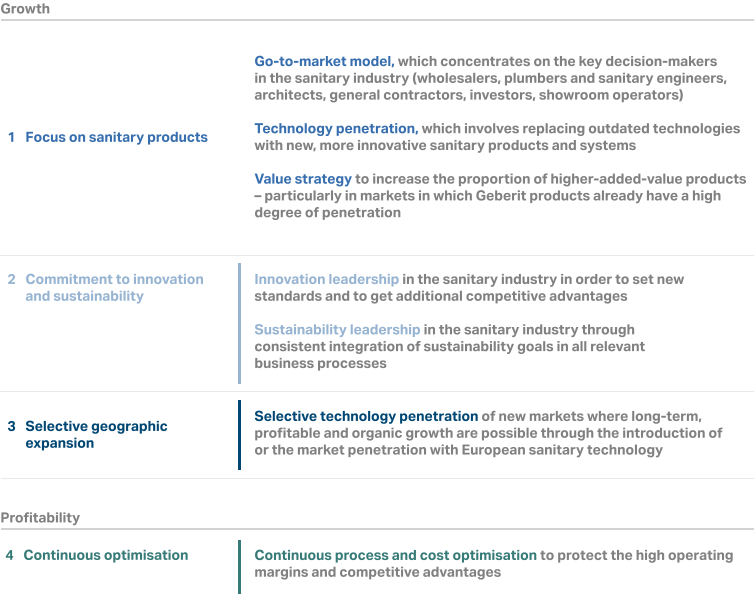
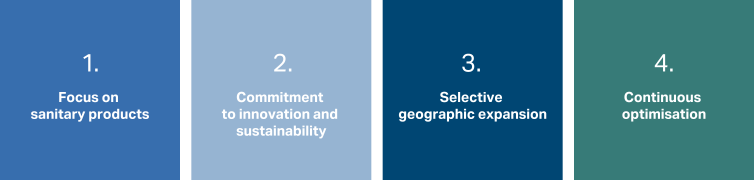
Guided by the principle “Mastering water – because people need excellent sanitary products”, Geberit stands for expertise in all aspects of water resources. As a European leader in the field of sanitary technology, the company develops, manufactures and sells durable, resource-saving and innovative products for new buildings and renovation projects. The business success is founded on a long-term business model that is based on strategic stability, continuous adaptability and operational flexibility. The proven, focused strategy for doing so is based on the four pillars “Focus on sanitary products”, “Commitment to innovation and sustainability”, “Selective geographic expansion” and “Continuous optimisation”.
Focus on sanitary products: Geberit concentrates on installation and flushing systems for sanitary facilities, piping systems for transporting water in buildings, as well as bathroom systems. In these areas, Geberit has comprehensive know-how and supplies high-quality, integrated and water-saving sanitary technology as well as attractive design.
Commitment to innovation and sustainability: Continuously optimising and extending the product range is crucial for future success. Innovative strength is founded on research in areas such as hydraulics, acoustics, statics, fire protection and hygiene, as well as process and materials technology. With the insights gained, in front of and behind the wall products are developed that are coordinated with each other and offer added value to customers as a system. The consistent focus here is on sustainability. For example, the reduction of water consumption in the product use phase is a core topic.
Selective geographic expansion: An important factor in the long-term success is stronger growth in markets in which Geberit products or technology are still under-represented. Outside Europe, Geberit concentrates on the most promising markets. These include, for example, Southeast Asia, Australia, the Gulf Region, South Africa, India and China. The company mainly engages in project business in these markets and always adheres strictly to the existing high standards in terms of quality and profitability.
Continuous optimisation: Efficient processes will help to establish a leading and competitive cost structure on a long-term basis. Process optimisation will be partly achieved through Group-wide projects and partly through employees identifying improvement potential in their day-to-day work, thus making a major contribution toward positive development.
The following growth and earnings drivers are crucial to implementing the strategy and achieving the ambitious medium-term goals: