

Water
Overview
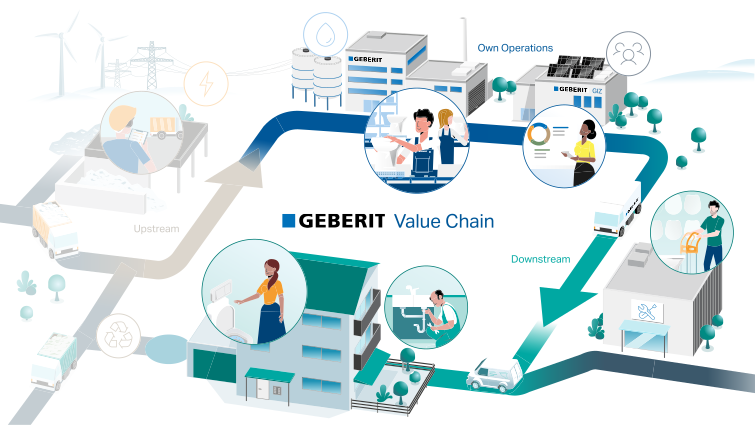
The significance of the topic of “Water” along the Geberit value chain
Reduction of water withdrawal per ceramic appliance (l/kg)
Reduction of water withdrawal in production
Impacts, risks and opportunities
As part of the double materiality assessment, two material opportunities but no significant risks or negative impacts were identified for the topic of water. The scope of the analysis includes all production sites as well as the logistics centre in Pfullendorf (DE).
The sub-topic “Marine resources” was excluded, as neither Geberit nor its suppliers have any material impacts in this area. Waste water is not directly discharged into the sea and marine resources (e. g. salt water) are not used in ceramic production. There were also no relevant risks or opportunities in terms of financial materiality.
The water risks connected to climate change are part of Group-wide risk management and are monitored continuously. According to the Water Risk Atlas published by the World Resources Institute (WRI), six production sites – Gaeta (IT), Koło and Ozorków (PL), Michigan City (USA), Shanghai (CN) and Pune (IN) – are located in areas with high water stress. The materiality assessment did not, however, reveal any significant impacts, risks or opportunities connected to climate-related risks. Developments will continue to be monitored.
Almost 100% of the water withdrawal at Geberit can be attributed to the product use phase and thus the downstream value chain. This means that the water requirements of sanitary products are of particular relevance. Geberit consistently develops water-saving systems in order to reduce water consumption in buildings.
The identified material opportunities in the “Water” area are listed below:
|
|
|
|
Time horizon |
|
Value chain |
||||||||
IRO description |
|
Type |
|
Short- |
|
Medium-term |
|
Long- |
|
Up- |
|
Own operations |
|
Downstream |
The use of water-saving sanitary systems can reinforce Geberit’s competitive position and lead to higher market shares, higher sales and income. |
|
Opportunity, potential |
|
|
|
|
|
|
|
|
|
|
|
|
A positive image in the area of water saving can reinforce brand recognition and customer loyalty, thus promoting the market position. |
|
Opportunity, potential |
|
|
|
|
|
|
|
|
|
|
|
|

Management system
The overall strategic responsibility for environmental matters and their management lies with the Board of Directors. Operational implementation is the responsibility of the Group Executive Board. They are supported here by Corporate Sustainability, which is responsible for implementing the sustainability strategy as well as managing water-related processes and activities.
Processes, measures and controls
Geberit consistently develops water-saving products. Water-saving solutions such as dual-flush and stop-and-go cisterns have, according to internal model calculations, decreased flush volumes since 1952 by around 80%. Based on sales figures in the reporting year, there is an annual savings potential of up to 163 million m3 water. The basis for the calculation is the assumption that a cistern with single 9-litre flush is replaced with a water-saving Geberit system as part of a renovation.
All production sites and the logistics centre in Pfullendorf (DE) are certified in accordance with ISO 14001 (environment) Group certificate. How the company handles water is constantly being optimised, for example through water treatment in the plants or reusing water in production processes and laboratories.
Most of the water withdrawal can be attributed to ceramic production. In this area, Geberit aims to reduce the annual water withdrawal (in l) per total volume of the produced ceramic appliances (in kg) by an average of 1% in accordance with its sustainability strategy.
The effectiveness of the measures is checked on a regular basis and relevant key figures are recorded annually.
Measures and key figures in the reporting year
In 2025, Geberit adapted the definitions and units of all water-related key figures, including water withdrawal, water consumption and water discharge, to comply with the requirements of the ESRS standard.
Water withdrawal
Water withdrawal in production increased in the reporting year to 915,442 m3 (previous year 880,759 m3). The increase is due to temporary measures in the technical infrastructure of a production plant. 41.5% of the water came from groundwater, 31.5% from the public supply, 25.7% from surface waterbodies and 1.3% from rainwater, see table:
|
|
2025 |
|
2024 |
|
Deviation |
||||
|---|---|---|---|---|---|---|---|---|---|---|
|
|
m3 |
|
m3 |
|
% |
||||
Public supply |
|
288,361 |
|
298,835 |
|
-3.5 |
||||
Groundwater |
|
379,660 |
|
382,467 |
|
-0.7 |
||||
Surface waterbodies |
|
235,268 |
|
192,593 |
|
22.2 |
||||
Rainwater |
|
12,152 |
|
6,865 |
|
77.0 |
||||
Water withdrawal |
|
915,442 |
|
880,759 |
|
3.9 |
||||
Water to sewage |
|
181,357 |
|
169,611 |
|
6.9 |
||||
Water to surface waterbodies |
|
531,575 |
|
500,723 |
|
6.2 |
||||
Water discharge |
|
712,932 |
|
670,334 |
|
6.4 |
||||
Water consumption |
|
202,510 |
|
210,426 |
|
-3.8 |
||||
|
||||||||||
According to an estimate, 16.5% of the total water withdrawal was treated and reused in the reporting year.
The manufacture of ceramic sanitary appliances accounts for around 80% of water withdrawal, above all for the preparation of the ceramic slip and glaze, and for cleaning the moulds. Water withdrawal per kilogram of ceramic fell compared to the previous year by 3.4% to 7.2 l/kg (previous year 7.5 l/kg). In addition, water is used for processes such as steam foaming, powder coating and in the sanitary facilities and laboratories in Rapperswil-Jona (CH). Thanks to numerous process optimisations, water withdrawal in production has decreased by a total of 21.8% since the reference year 2015.
149,913 m3 or 16.4% of the water withdrawal is in areas with high water stress. According to the Water Risk Atlas published by the World Resources Institute (WRI), these include the plants in Gaeta (IT), Koło and Ozorków (PL), Michigan City (USA), Shanghai (CN) and Pune (IN).
|
|
2025 |
|
2024 |
|
Deviation |
||||
|---|---|---|---|---|---|---|---|---|---|---|
|
|
m3 |
|
m3 |
|
% |
||||
Public supply |
|
16,951 |
|
16,938 |
|
0.1 |
||||
Groundwater |
|
131,240 |
|
139,211 |
|
-5.7 |
||||
Surface waterbodies |
|
0 |
|
0 |
|
- |
||||
Rainwater |
|
1,722 |
|
605 |
|
184.6 |
||||
Water withdrawal |
|
149,913 |
|
156,754 |
|
-4.4 |
||||
Water to sewage |
|
33,909 |
|
31,806 |
|
6.6 |
||||
Water to surface waterbodies |
|
75,697 |
|
81,034 |
|
-6.6 |
||||
Water discharge |
|
109,605 |
|
112,840 |
|
-2.9 |
||||
Water consumption |
|
40,308 |
|
43,915 |
|
-8.2 |
||||
|
||||||||||
Water consumption
202,510 m3 water was consumed in the reporting year (-3.8% compared to the previous year). This equates to 22% of the entire water withdrawal. Consumption is mainly due to evaporation losses, for example in cooling processes in production and drying in ceramic production. In areas with high water stress, water consumption totalled 40,308 m3 (-8.2% compared to the previous year).
Although Geberit aims to reduce the water withdrawal, water consumption is also continuously optimised, particularly by increased efficiency in production processes.
Water discharge
Waste water is treated at all production sites before being discharged. In ceramic production, process waste water undergoes sedimentation and filtration before being fed into the receiving surface waterbodies. Particularly contaminated waste water from industrial processes, such as powder coating, electroplating or metal cleaning, is treated locally before it is discharged into the public sewage system together with the other waste water.
78% of the withdrawn water was discharged. The volume of waste water amounted to 712,932 m3 (previous year 670,334 m3). In accordance with the local provisions, 74.6% was treated and returned to surface waterbodies and 25.4% fed into the sewage system. The largest share was process waste water from ceramic production at 74.2%, followed by domestic waste water at 23.9% (waste water from sanitary use). The remaining industrial waste water, which was fed into a communal waste water treatment plant, accounted for a minor share of 1.9%. There was no external reuse of waste water.
|
|
2025 |
|
2024 |
|
Deviation |
||||
|---|---|---|---|---|---|---|---|---|---|---|
|
|
m3 |
|
m3 |
|
% |
||||
Sanitary waste water |
|
170,225 |
|
161,037 |
|
5.7 |
||||
Ceramic process water |
|
529,419 |
|
498,376 |
|
6.2 |
||||
Other industrial waste water |
|
13,288 |
|
10,921 |
|
21.7 |
||||
Water discharge |
|
712,932 |
|
670,334 |
|
6.4 |
||||
|
||||||||||
Definitions and calculation bases
Where available, Geberit relies on primary data from data recording systems found within the Group.
Water withdrawal: Water taken from natural sources (such as rivers, lakes, groundwater), regardless of whether it is returned to the cycle after use or not. Proprietary measurements at all Geberit production sites serve as the basis for calculation.
Water consumption: The amount of water permanently removed from availability through evaporation or incorporation into products. The basis for calculation is the difference between water withdrawal and water discharge.
Water discharge: Water that is returned to the original water source after use. Proprietary measurements at the Geberit production sites serve as the basis for calculation.